At sixteen, Hafez Modirzadeh got a lesson in alternate fingerings from Sonny Stitt. Two years later he was studying Javanese gamelan at San Jose State under Lou Harrison. Somewhere in between he began thirty years of study with the Iranian expatriate violinist Mahmoud Zoufonoun, learning the dastgah system and the microtones that sit between the notes a Western saxophone was built to play. Almost nobody else's biography reads like that, and almost nobody else's music sounds like it either.
Modirzadeh was born in Durham, North Carolina, to an Iranian father and a mother of Irish and Ashkenazi Jewish descent, a mixed inheritance he has spent his career treating as a method rather than a biographical footnote. His 1992 doctoral dissertation at Wesleyan coined the term chromodality for a framework that let jazz harmony and Persian dastgah modes occupy the same tuning system without either one bending to fit the other. He has taught at San Francisco State University for decades and holds two senior Fulbright fellowships, the first for research into flamenco and Gnawa music, the second into Turkish harmonic practice.
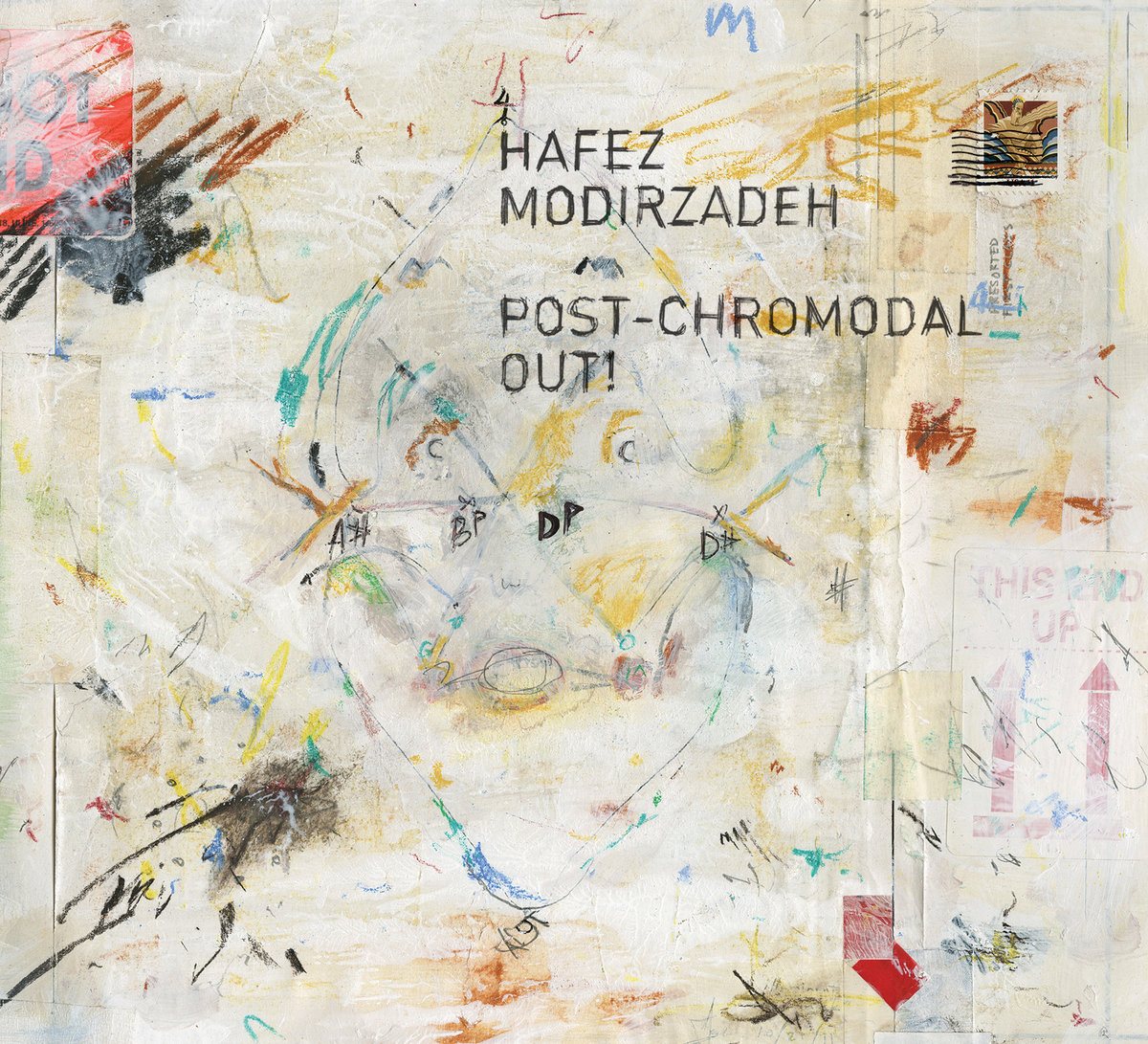
Post-Chromodal Out!, released on Pi Recordings in 2012, marks a turn beyond chromodality itself. Modirzadeh has traced the shift to a 2007 meeting with Ornette Coleman, after which he began looking for a tuning approach with no home culture at all, one where equal temperament, just intonation and Persian microtonality could sit in the same chord without any of them claiming priority.
The clearest evidence is the piano. Vijay Iyer plays it here retuned to intervals Modirzadeh describes as larger than a quarter tone but smaller than a Western half-step, spliced in among ordinary tempered notes, so that a single chord can contain both the familiar and the faintly wrong. Around him, trumpeter Amir ElSaffar bends pitch with his embouchure rather than a valve, bassist Ken Filiano and drummer Royal Hartigan hold a jazz rhythm section's shape while everything above them slides, and guest players add kulintang gongs, courtesy of the Filipino master Danongan Kalanduyan, and Persian santur, played by Faraz Minooei, without the record once feeling like a tour through separate traditions rather than one language.
The album unfolds as two suites, Modirzadeh's own Weft Facets and a commissioned companion, Wolf and Warp, by James Norton. Iyer, writing about the sessions, has praised their synthesis across traditions and singled out a clarity that survives the theoretical density underneath it, which is the right way in: Post-Chromodal Out! rewards a listener who ignores the tuning charts and simply notices how strange and settled the chords sound at once.