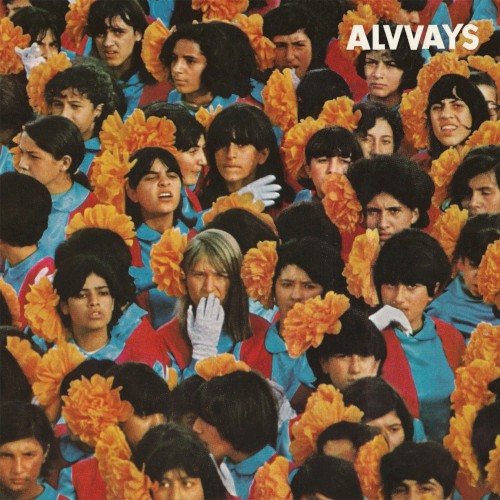
Before Alvvays became standard-bearers for a generation of guitar-pop bands, they were young Maritime musicians trying to make adulthood sound less inevitable. Singer-guitarist Molly Rankin and keyboardist Kerri MacLellan grew up next door to each other in Cape Breton, absorbing fiddle tunes and folk songs; guitarist Alec O’Hanley, bassist Brian Murphy and drummer Phil MacIsaac came from Prince Edward Island. Convening in Toronto, the quintet carried those melodic instincts into music concerned with people stranded between youthful latitude and the contracts—romantic, financial, professional—that supposedly follow.
Recorded before the band had a record deal, Alvvays was cut in March 2013 at Chad VanGaalen’s Yoko Eno studio in Calgary. The surroundings mattered. Rankin remembered African music, vibraphones and odd instruments filling VanGaalen’s colourful workspace; he brought a percussionist’s imagination to the sessions, including modular beats and, at one point, a drum struck with a spoon. Graham Walsh of Holy Fuck undertook additional, more improvised basement tracking, while John Agnello mixed the results in Brooklyn. This chain of contrasting environments helps explain the album’s peculiar finish: precise without sounding sanitised, battered without becoming murky.
Pitchfork called it “pristine pop music blasted through cheap, blown-out headphones,” an unusually durable description. Rankin and O’Hanley write melodies with the immediate sweetness of C86 jangle, Teenage Fanclub or Camera Obscura, but abrasion keeps disturbing the picture: guitars fray at the edges, keyboards blur the horizon and drum machines appear where tasteful revivalism would demand restraint. The record belongs to a jangling continuum, yet its Maritime inheritance—plain speech, fatalism, melody used as emotional misdirection—makes it more than an exercise in borrowed record collections.
That friction is sharpest in “Archie, Marry Me,” a proposal that treats matrimony as both romantic leap and administrative trap. Rankin’s deadpan delivery lets devotion coexist with student debt and resistance to social expectation; the pearly guitar figure supplies the certainty the narrator cannot. Elsewhere, “Adult Diversion” turns infatuation into surveillance, “Next of Kin” slips death into buoyant pop, and “Atop a Cake” finds another ceremony shadowed by doubt. Even the synth-led closer “Red Planet” imagines escape as loneliness. Across nine songs and barely 33 minutes, hooks recur quickly enough to feel less like decoration than thoughts someone cannot stop revisiting.
Released on July 22, 2014, Alvvays reached the 2015 Polaris Music Prize shortlist. The band enlarged its emotional and sonic vocabulary on 2017’s Antisocialites and 2022’s Blue Rev, which won the 2023 Juno for Alternative Album of the Year; “Belinda Says” earned their first Grammy nomination the following year. A tenth-anniversary vinyl edition, remastered by Bernie Grundman and supplemented by “Underneath Us,” arrived on November 15, 2024. Its endurance confirms the debut’s central insight: growing up is not a clean transition, but a bright melody continually interrupted by noise.