By 1968, Brigitte Fontaine already had two albums and a hit theatre show behind her. Most of the French underground that the revolution produced had nothing behind them at all, which is presumably why May '68 didn't turn Fontaine into someone new so much as give her permission to keep going, further than before.
She had left Brittany for Paris at seventeen to act, found her way into singing by 1963, and built her name partly through "Maman j'ai peur," a stage show she wrote with Jacques Higelin and Rufus that toured Europe for two seasons. By 1971 she had also signed the Manifesto of the 343, the public declaration by hundreds of French women that they had had illegal abortions. The same appetite for exposure runs through everything she went on to make with Areski Belkacem, the Kabyle multi-instrumentalist Higelin introduced her to in 1969, with whom she never really stopped working.
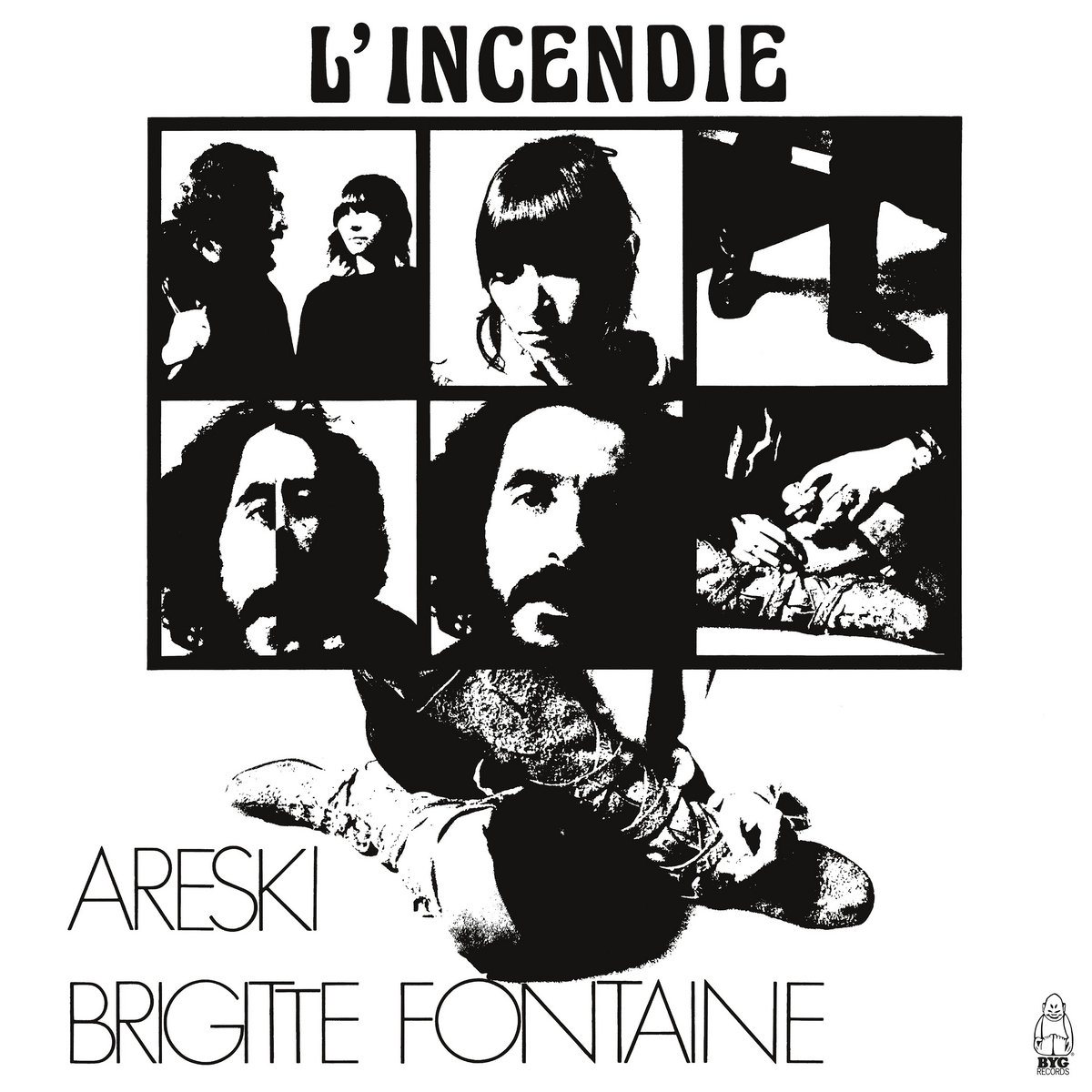
By the time the pair made L'Incendie for BYG in 1973 — her seventh album, his fifth, their third together — they had already cut Comme à la radio with the Art Ensemble of Chicago, a record that put an end to any doubts about how far Fontaine was willing to take things. L'Incendie doesn't chase that album's free-jazz heat.
It is quieter, and stranger for being quiet.
Fontaine wrote most of the music and Areski most of the words, and on "L'Abeille" they swapped jobs, as if to prove the division had never been fixed in the first place. Thirteen songs move between hushed chanson, unaccompanied vocal experiments and passages that gallop through jazz, rock and whatever else was within reach, without settling into any one of them long enough to be filed. "Le 6 Septembre" takes its title from the Jordanian crisis then known as Black September; "Les Petites Madones" goes after capital punishment; "L'Engourdie," quieter than either, would become one of the record's most enduring songs.
None of it plays like protest music. Fontaine's gift has always been for making the political sound domestic and the domestic sound deranged, frequently within the same line, so that the record's politics arrive disguised as gossip and its gossip arrives disguised as prophecy.
Areski and Fontaine had been working together for four years by the time L'Incendie appeared, long enough to stop explaining the rules to each other and start making a habit of breaking them instead. They had already staged the improvised show "Niok" together at the Lucernaire, treating theatre and record-making as branches of the same activity, and L'Incendie carries that same refusal to separate the two. It doesn't sound like a stepping stone between better-known Fontaine albums. It sounds like a method arriving fully formed, in a language only the two of them speak.