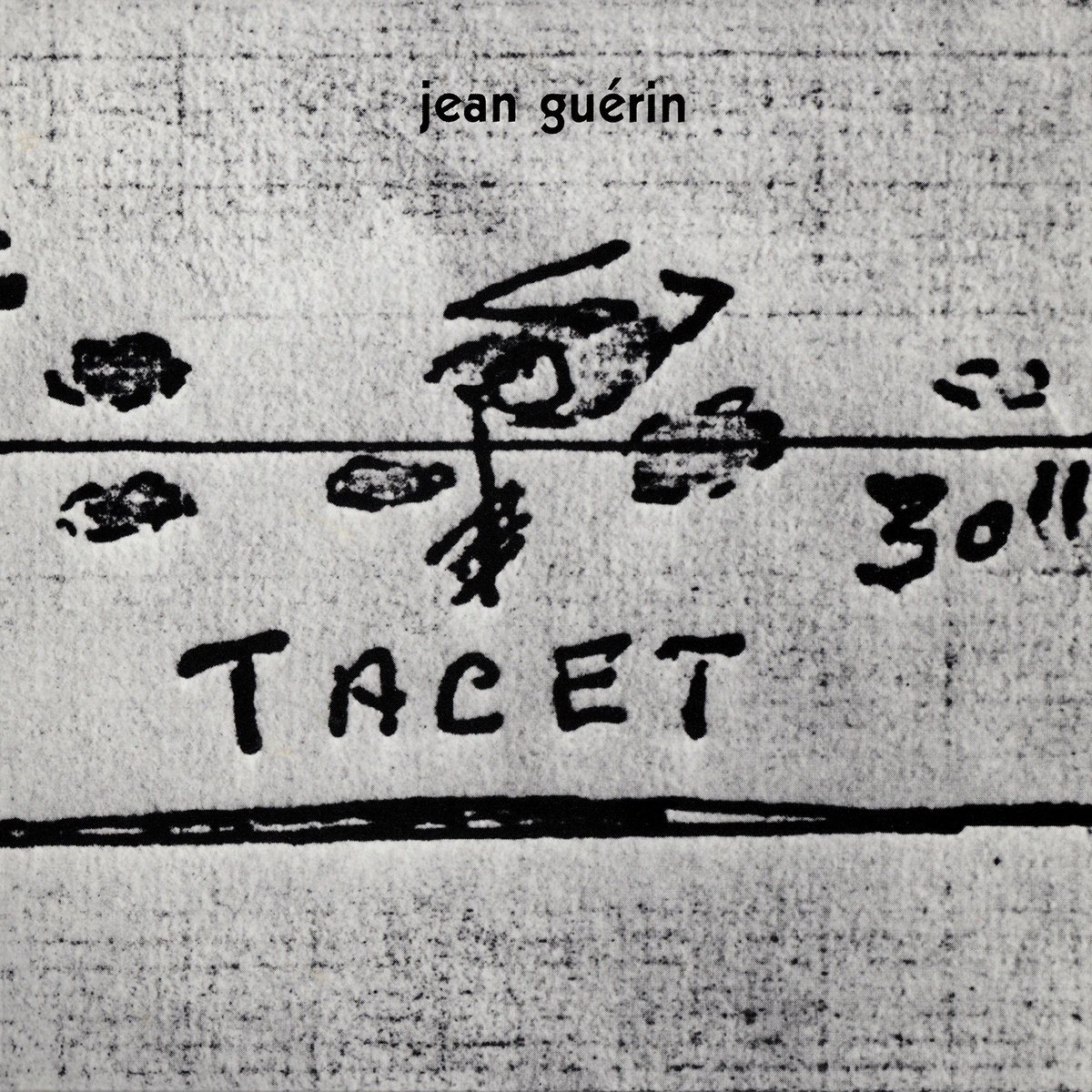
The most unsettling thing about Tacet is not its electronics. It is the way Jean Guérin makes acoustic instruments stop behaving like themselves. Trumpets flare and recede as if someone is changing their voltage; voices arrive without language; percussion can feel less like rhythm than a physical disturbance in the room.
Recorded in January 1971 at Ossian and Magne studios, with overdubs and mixing at Europasonor, Guérin’s eight-track album grew from his music for Claude Faraldo’s film BOF… Anatomie d’un livreur. Yet Tacet works less like a conventional soundtrack than a laboratory assembled from the same raw material. Guérin composed the record and handled an unusually broad arsenal himself: electric bass, darbouka, percussion, vocals, electronic drums, generator and VCS3 electronics.
That combination matters. Early electronic music can announce its machinery with solemnity; Guérin treats circuitry as one more unstable participant in an ensemble. On Triptik 2, tenor saxophone and trumpet are not set against electronics so much as pulled into their logic. The distinction between player and processing starts to blur. Across the album, pulses emerge and vanish, tones stretch into ambiguous textures, and abrupt gestures make silence feel structural rather than empty.
The cast is small enough for every intrusion to register. Philippe Maté contributes tenor saxophone, Jean Paul Rondepierre trumpet, Dieter Guévissler bass and cello, while Françoise Achard adds vocals. Guérin also shares mixing credits with Charles Rocher, Claude Martenot and Daniel Naudin. The result has the density of musique concrète without losing the nervous reflexes of improvised jazz.
Réflexion 2 Et 1 makes the record’s method especially clear. Repetition becomes a kind of unstable clock, but Guérin never lets the surrounding sounds settle obediently around it. Elsewhere, the short BM 37 functions almost like a pressure change before the album opens outward again, culminating in the eight-minute Gaub 71.
What makes Tacet compelling in 2026 is how little it depends on the retro charm of analogue equipment. The VCS3 is not the story. Guérin’s real subject is permeability: jazz can become sound design, a soundtrack can become an autonomous album, percussion can become texture and the studio itself can become an instrument.
That leaves Tacet difficult to file neatly, which is precisely its strength. It belongs to the French free-jazz underground, but it keeps slipping sideways from jazz into electroacoustic composition and psychedelic abstraction. Fifty-five years after its recording, it still sounds less like a period piece than a room whose walls have not stopped moving.