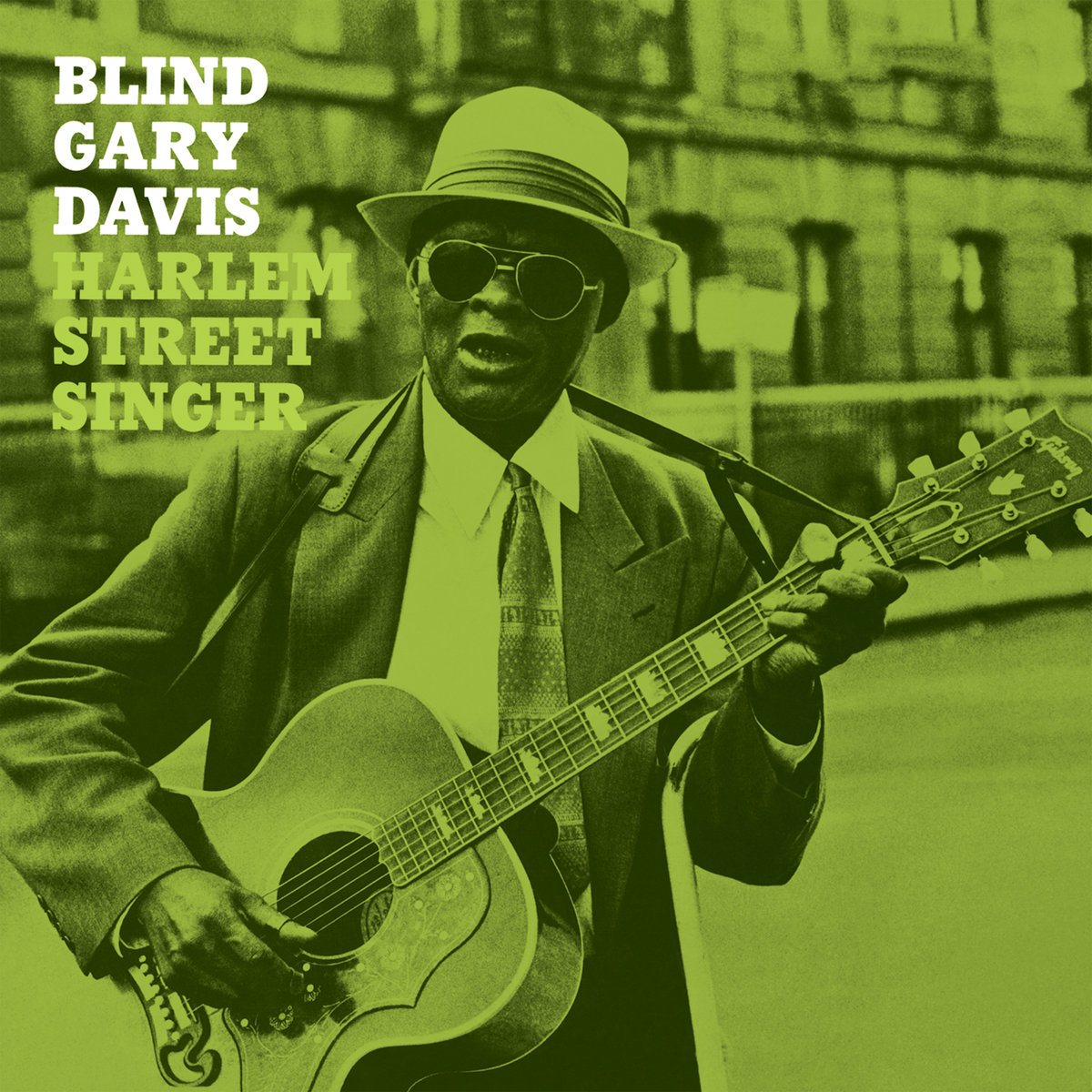
Twelve songs, one man, one afternoon. Harlem Street Singer was recorded on 24 August 1960 at Rudy Van Gelder's studio in Englewood Cliffs, New Jersey, a room better known for Blue Note hard bop than for a blind Baptist preacher with a guitar. Kenneth Goldstein supervised, Bluesville put it out that December. It was an odd pairing: the most meticulous engineer in jazz, and a performer whose art had been shaped by street corners where nobody was listening closely.
Gary Davis was born in Laurens, South Carolina, in 1896 and lost his sight before he was a month old. By the late 1920s he had settled in Durham, North Carolina, where he taught Blind Boy Fuller and cut fifteen sides for the American Record Company in 1935. Only two of them were blues. Davis had already decided where his music belonged, and after his ordination in 1937 the secular songs mostly went into a drawer. "Cocaine Blues" and "Candy Man" survived because his pupils kept asking for them. In January 1944 he moved with his wife Annie to the East Bronx and spent the next decade preaching and playing on the pavement uptown.
What the pavement taught him is audible everywhere on this record. Davis picked with thumb and one finger, and the thumb does an unreasonable amount of work: bass lines that walk, run and answer the melody as if a second guitarist were sitting in. On "Samson and Delilah" the accompaniment surges and stalls under the vocal like a congregation swaying; on "Death Don't Have No Mercy" it slows to a dread-laden crawl, each descending phrase landing a beat behind the words. His voice is a preacher's instrument, hoarse and enormous, and Van Gelder's close miking catches the breath between lines and the squeak of a hand shifting up the neck. Not a pretty sound; a true one.
The timing was not accidental. In 1960 Davis began a residency at Gerde's Folk City, a year after his first Newport Folk Festival appearance, and young guitarists in Greenwich Village were already queuing to sit at his feet. Dave Van Ronk, Stefan Grossman, David Bromberg and Rory Block all took lessons; Bob Weir would later name him as an influence. Peter, Paul and Mary recorded "Samson and Delilah" as "If I Had My Way" on their 1962 debut album, and by 1964 the royalties had bought Davis a small house in Jamaica, Queens. The Grateful Dead put the same song on Terrapin Station; the Rolling Stones split "You Gotta Move" between him and Fred McDowell on Sticky Fingers.
Davis made further albums for Prestige, toured Britain several times between 1964 and 1971, and died in May 1972, days after his seventy-sixth birthday. Craft Recordings' 2024 remaster puts the Van Gelder session back in front of a generation raised on his descendants. It is the place to start, and the place most of them started too.