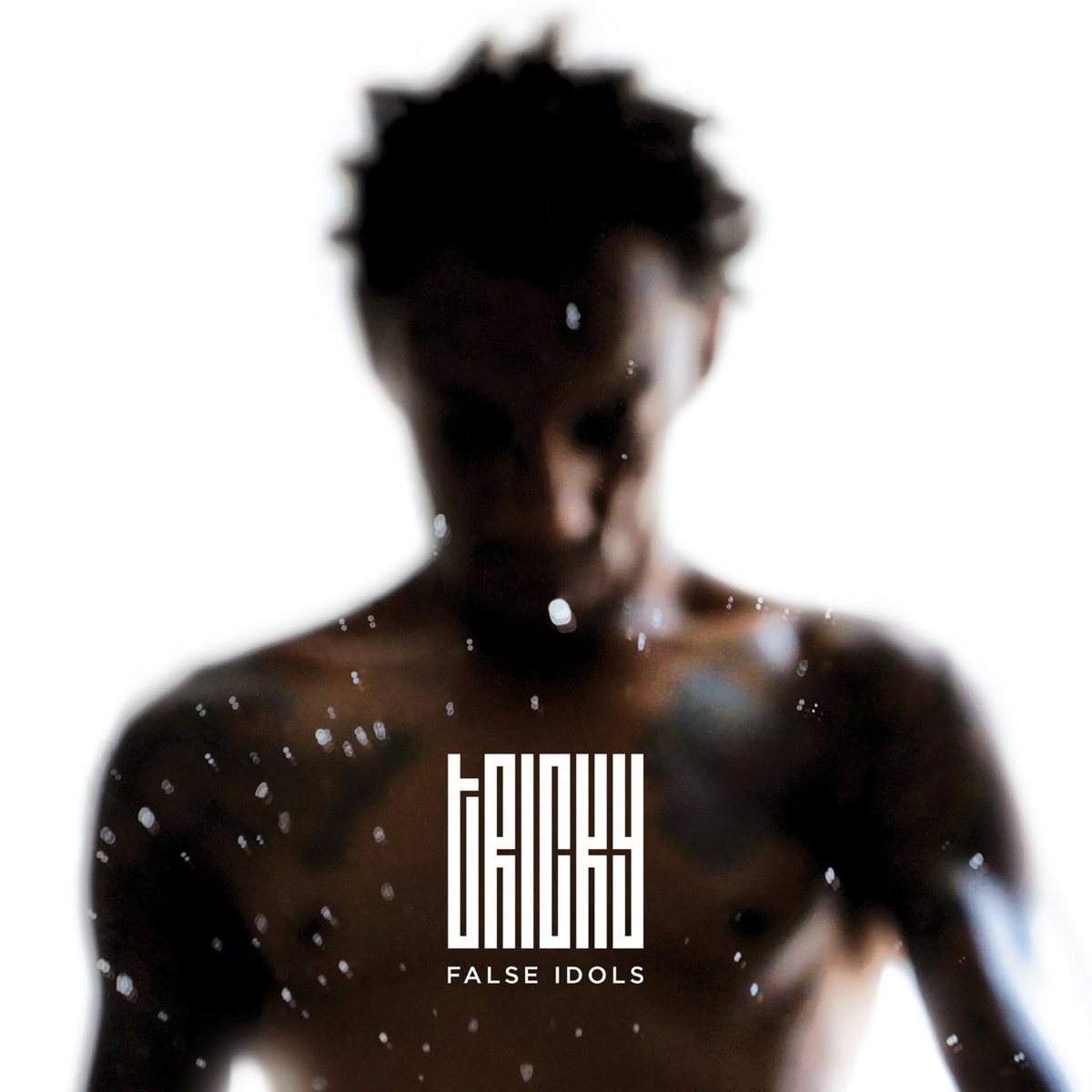
The most revealing thing about False Idols is not that it sounds like Tricky again. It is how little Adrian Thaws needs to make that recognition happen: a bass line with bad intentions, a voice close enough to hear breathing, a beat that seems to distrust the room around it.
Released in May 2013, the album arrived with a practical declaration of independence. Tricky had created False Idols, his own imprint in association with !K7, after records for Domino and years of stylistic movement that had taken him well beyond the claustrophobic language associated with his 1995 debut Maxinquaye. Naming both label and album the same thing makes the project feel less like branding than a reset.
That reset is audible immediately. Somebody's Sins opens with the famous defiance from Patti Smith's Gloria, placed over a low, sparse arrangement. Throughout the record, Tricky works by subtraction. Percussion arrives as pressure rather than propulsion; bass occupies physical space; guitars and electronics appear in fragments. His own half-spoken delivery rarely behaves like a conventional lead vocal. It rubs against other voices, doubles them or disappears behind them.
Francesca Belmonte is central to that architecture. Her presence across the album gives songs such as Nothing's Changed and Does It a human surface that Tricky can disturb from underneath. Elsewhere the cast widens without turning the record into a guest list. Nigerian singer Nneka appears on Nothing Matters; Fifi Rong contributes to If Only I Knew and Chinese Interlude; Peter Silberman of The Antlers enters Parenthesis, a reworking connected to his band's Parentheses.
The choices are characteristic of Tricky's method. He has always treated authorship as something porous. His early work with Massive Attack and the subsequent partnership with Martina Topley-Bird established a vocabulary in which masculine and feminine voices could occupy the same song without settling into neat roles. False Idols revisits that tension without trying to reconstruct Bristol in the 1990s.
That distinction matters. The record's slow tempos, dub weight and nocturnal electronics belong to the history that helped make “trip hop” a useful shorthand, but Tricky has never sounded comfortable inside shorthand. Valentine folds the standard My Funny Valentine into his own atmosphere; Hey Love draws on Japan's Ghosts. These references become raw material rather than nostalgia.
By 2013, returning to sparseness could easily have looked like retreat. Instead False Idols sounds like an artist identifying which parts of his language remain necessary. Thirteen years on, its unease has not been tidied away. The empty space is still doing half the work.