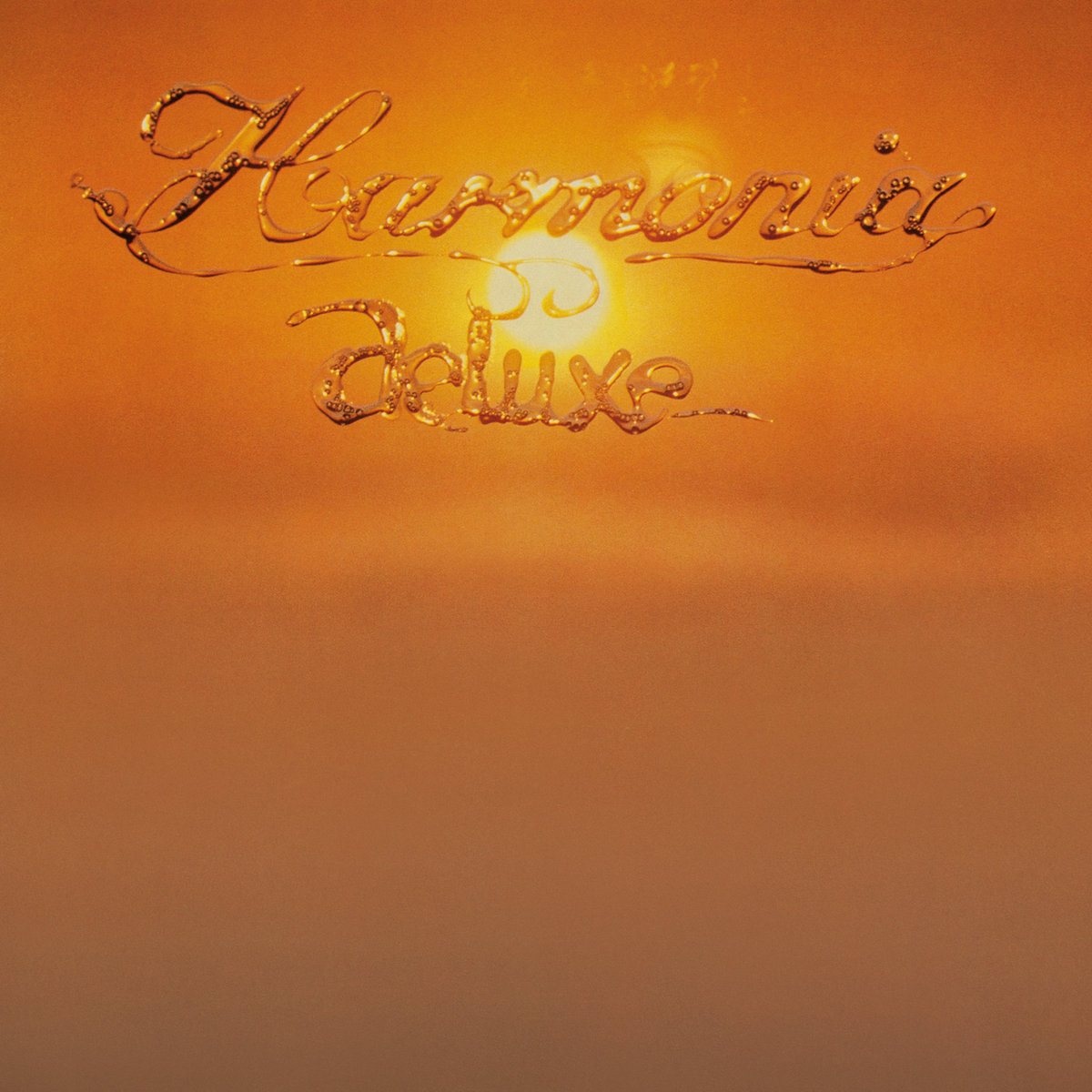
Harmonia’s Deluxe moves without appearing to hurry. A kick drum can hold one direction for minutes while keyboards shimmer at the edges and Michael Rother’s guitar draws a clean line across the middle. The music advances, but the landscape seems to stay still.
That paradox comes naturally to a group formed in rural Forst from two distinct musical partnerships. Hans-Joachim Roedelius and Dieter Moebius had moved Cluster away from Berlin’s experimental underground towards increasingly concise electronic forms. Rother, meanwhile, had developed a different idea of repetition with Neu!: guitar as horizon, rhythm as continuous road.
Harmonia gives those instincts a common room.
The trio formed in 1973, and Deluxe, their second album, was recorded in June 1975 at their studio in Forst. Conny Plank, already central to the recorded histories of Cluster and Neu!, co-produced and engineered. Guru Guru drummer Mani Neumeier appears on the album too, adding acoustic percussion without displacing the electronic pulse underneath.
The title track makes the arrangement clear. Rother’s guitar is bright and sustained rather than riff-heavy; keyboards establish repeating figures; voices enter almost as another rhythmic colour. Neumeier’s drums give the piece physical lift, but the performance never turns into conventional rock. Its pleasure lies in continuity, in hearing small changes register against an unusually stable background.
“Monza (Rauf und runter)” pushes harder, its motor rhythm and guitar making the Neu! connection explicit without reducing Harmonia to a side project. Elsewhere, “Notre Dame” and “Gollum” lean towards the more peculiar electronic vocabulary of Roedelius and Moebius: rounded keyboard tones, unstable textures, little mechanical details that prevent the surfaces becoming too immaculate.
That tension is the album’s real character. Rother tends towards clarity and melodic extension; Moebius can introduce abrasion or an awkward angle; Roedelius has a gift for phrases that feel intimate even when played on electronics. Plank gives each element enough space to remain legible.
The result belongs to the mid-1970s German experimental scene, but Deluxe is less interested in announcing modernity than in making technology feel lived-in. Synthesizers and processed guitar are treated like furniture in a farmhouse studio: useful objects, handled daily.
Harmonia named themselves after agreement, but their music works because the personalities never disappear. Deluxe is three approaches to motion occupying the same track, each pulling slightly differently while the whole thing keeps moving forward.