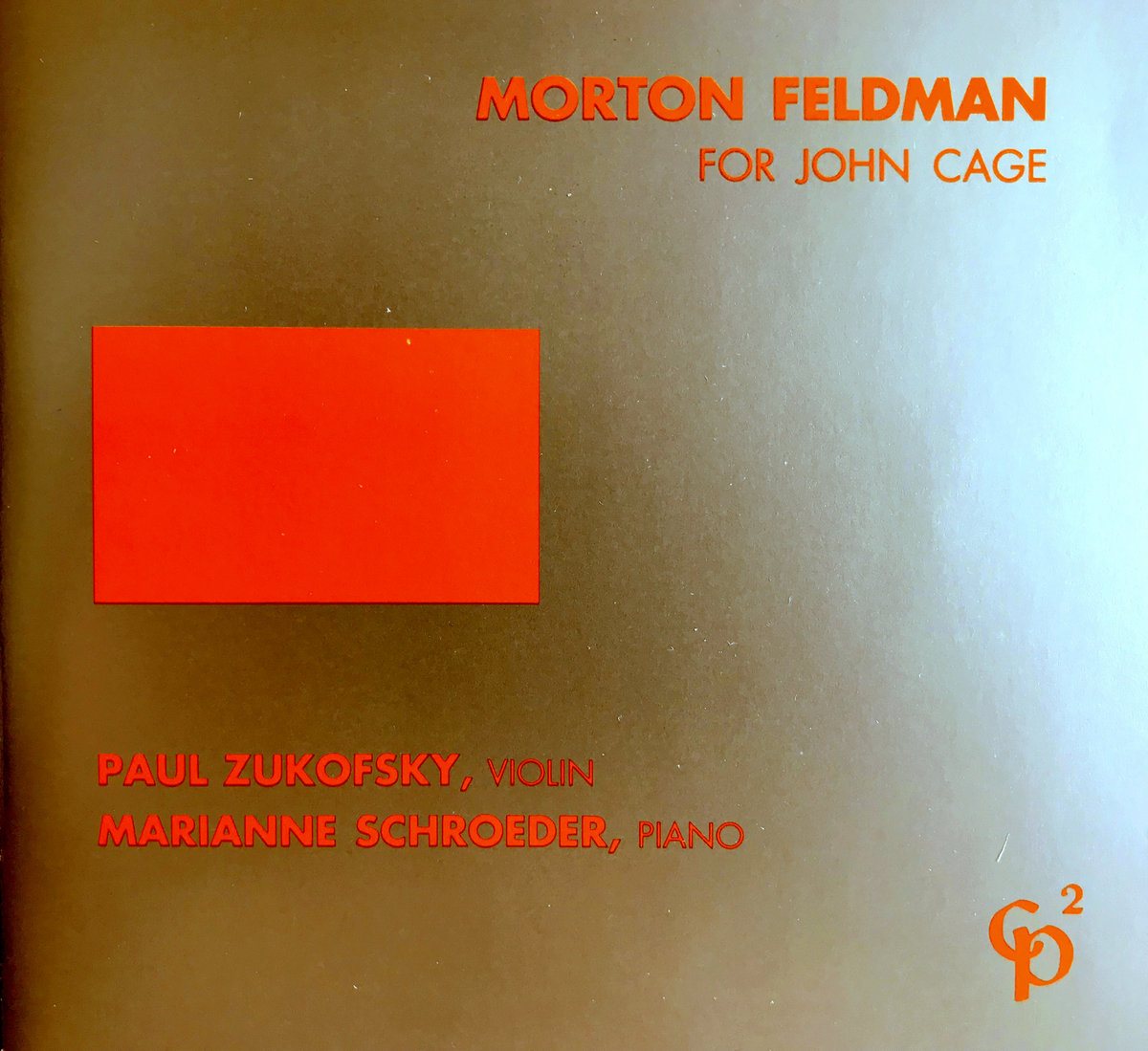
Morton Feldman spent his late career writing pieces that ask an audience to sit still for longer than seems reasonable, and For John Cage, finished in 1982, is one of the clearest examples: seventy-five minutes for violin and piano, dedicated to the friend and rival who had spent three decades needling him toward radical patience.
The performance musical observations has put out under Feldman's name doesn't come from a random pairing.
Paul Zukofsky, the violinist here, was a former child prodigy who made a career out of turning away from the concerto circuit and toward composers other soloists found too strange or too plainly difficult, premiering works by Roger Sessions, Charles Wuorinen and Philip Glass and recording Cage's Freeman Etudes, a set written specifically for his hands. He and Feldman had history: Zukofsky championed the composer's violin writing at a time when much of it was barely performed, and in 1975 founded Musical Observations as a nonprofit built to keep exactly this kind of recording in circulation rather than leaving it to major labels with no patience for a seventy-five-minute duet.
His partner on the recording, the Swiss pianist Marianne Schroeder, brings a different lineage into the room.
Trained under Giacinto Scelsi and later a regular collaborator of Anthony Braxton, Schroeder came to Feldman's music through the same appetite for extended technique and unresolved harmony that shaped her work in free improvisation. That background matters here: For John Cage isn't built from melody so much as from single tones and quiet clusters set against long silences, and it rewards a pianist who treats space as material rather than as something to fill.
What comes through, across the piece's considerable length, is conversation rather than performance.
Zukofsky and Schroeder trade figures so sparse that a single mistimed entrance would expose the whole structure, yet the recording never sounds tentative. It sounds like two musicians who trust the composer's arithmetic completely, which is really the only way this music works at all. Feldman wrote For John Cage a quarter-century into a friendship built on disagreement as much as admiration, and the title reads less like a tribute than an argument continued in a more patient register. Hearing it played by two performers this steeped in that same tradition of unglamorous, demanding new music gives the piece a weight a starrier pairing might not have earned.