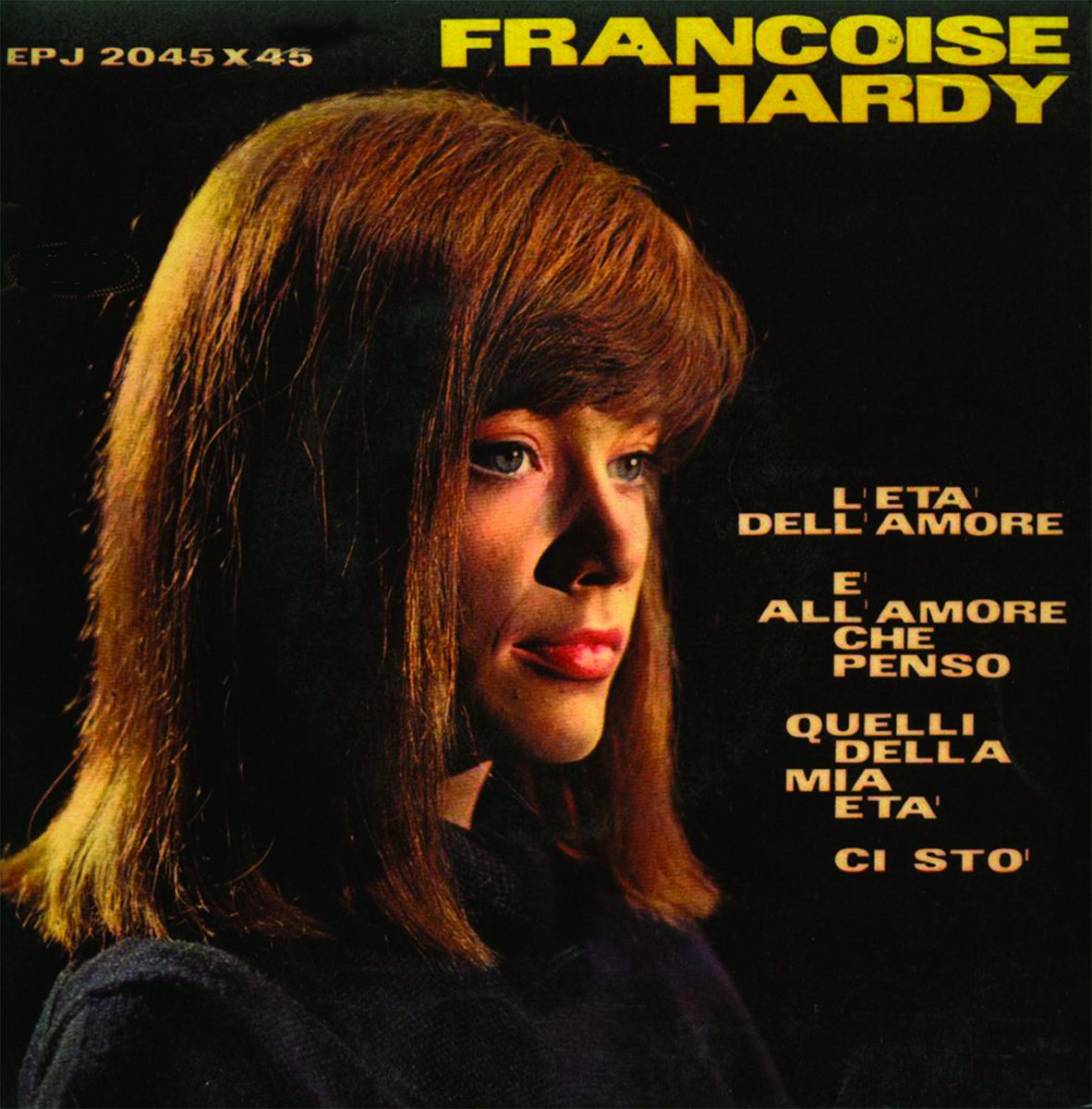
Before Jacques Dutronc was Françoise Hardy's husband, he was one of the anonymous hands at Disques Vogue who wrote her tunes for a session fee. One of those tunes became "Le Temps de l'Amour" in 1962. A year later it became "L'Età Dell'Amore," sung entirely in Italian, by a twenty-year-old who had never studied the language.
Hardy had already made herself impossible to ignore. "Tous les Garçons et les Filles" had sold half a million copies in France within months of its release, boosted by an unlikely slot on televised election coverage, and by 1963 she was the country's most exportable pop singer, breathy and melancholic in a scene otherwise built on brightness. Vogue's answer was to send her abroad in every language it could sell: English, German, Spanish, and, with real commercial intent, Italian.
"L'Età Dell'Amore" and its pairing, "È All'Amore Che Penso," were cut as a Milan single, with Italian lyrics by Vito Pallavicini fitted over the French arrangements under producer Jacques Wolfsohn's supervision.
The record isn't a novelty.
Pallavicini doesn't merely translate the original's ache over lost time; he tightens it, trading Hardy's plainer French phrasing for the rounder, more theatrical vowels Italian pop demanded of its singers that year. Hardy, singing phonetically, doesn't try to sound Italian. She sounds like herself, filtered through a language that isn't quite obeying her, and the slight strain becomes the performance's most interesting quality. It's the sound of a singer who had already worked out that her voice, not her lyrics, was the instrument worth exporting.
That instrument would go on doing this for six decades, restlessly: baroque orchestration with Charles Blackwell, the folk-adjacent turn of the 1970s made with the Brazilian arranger Tuca, later records with Air and Blur. Hardy kept moving after most of her yé-yé contemporaries had settled into nostalgia acts. She stopped singing publicly in 2021, when illness took her voice, and died in Paris in June 2024, at eighty, having spent a career treating reinvention as a baseline condition rather than a crisis.
SAAR Records' reissue of the Italian single doesn't dress it up with context or apology. It simply puts back into circulation a two-and-a-half-minute artefact of a very specific commercial moment: a French label testing whether its biggest asset could travel, and a young singer discovering, in real time, that she could go almost anywhere and still sound entirely like no one else.