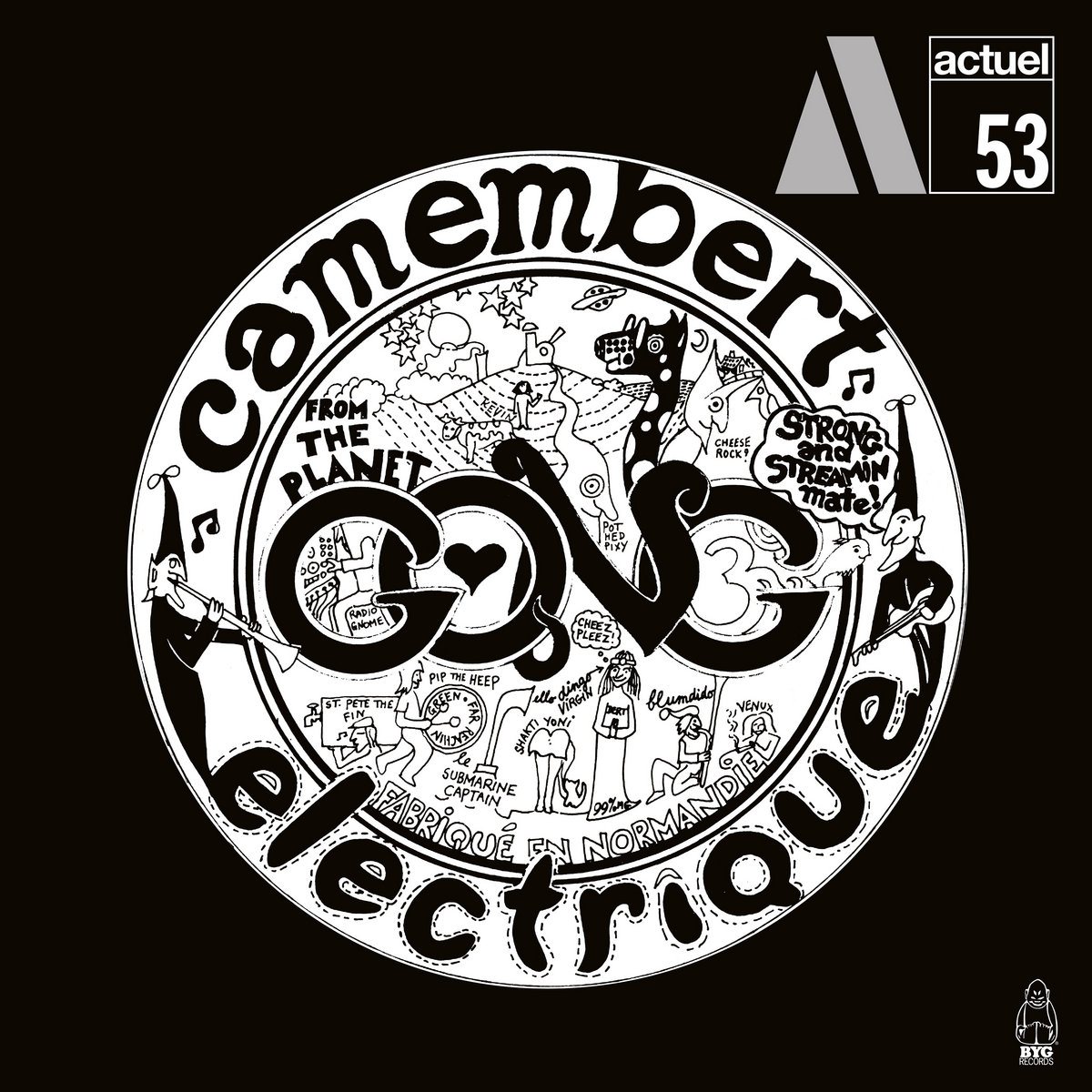
Camembert Electrique starts by refusing to behave like an album. A tiny radio transmission ushers you into Gong’s frequency; from there, songs stretch, mutate and interrupt one another until the record feels less like a sequence of tracks than a place with its own weather.
By 1971, Daevid Allen had already travelled an unusual route to this point. The Australian guitarist had been a founder member of Soft Machine before forming Gong in 1969. On the band’s second album, released in France by BYG/Actuel, his taste for psychedelic guitar and absurdist theatre finally locks into a line-up capable of making the jokes musically consequential.
Allen sings and plays guitar alongside Gilli Smyth, whose “space whisper” is one of Gong’s defining textures. Didier Malherbe moves between saxophones and flute, Christian Tritsch handles bass and guitar, and Pip Pyle drums with the kind of restless precision that lets the music change shape without collapsing. Eddy Louiss contributes Hammond organ and piano, while Konstantin Simonovitch supplies phased piano.
The record’s humour is obvious from titles such as Squeezing Sponges Over Policemen’s Heads, but treating Gong as a novelty act misses the discipline underneath. You Can’t Kill Me has a tough, repetitive guitar drive that keeps being needled by Malherbe’s reeds. Fohat Digs Holes in Space, written by Allen and Smyth, pushes further out: voices, guitar and rhythm circle one another until psychedelia becomes less a decorative effect than a method of arrangement.
Then there is Tropical Fish: Selene, seven and a half minutes in which the group’s competing instincts become complementary. Jazz phrasing sits inside rock momentum; Smyth’s voice behaves like atmosphere; Allen’s guitar can be wiry rather than grand. Gong are progressive without the architectural solemnity that the word often implies.
That looseness is carefully framed. The brief radio pieces and sound collages around the longer songs make Camembert Electrique feel broadcast from somewhere slightly adjacent to reality. The mythology is playful, but it also gives the band permission to abandon normal rock hierarchy: saxophone can carry the momentum, a whisper can become a lead instrument, and a comic interlude can be as structurally useful as a chorus.
The album was recorded in France in 1971 and later licensed to Virgin in the UK in 1974. Its real achievement, though, is internal. Gong found a way to make free-jazz reflexes, psychedelic colour and pop mischief coexist without sanding off their contradictions.
Camembert Electrique is funny because Gong are serious about play. That distinction is why its private universe still feels inhabitable.