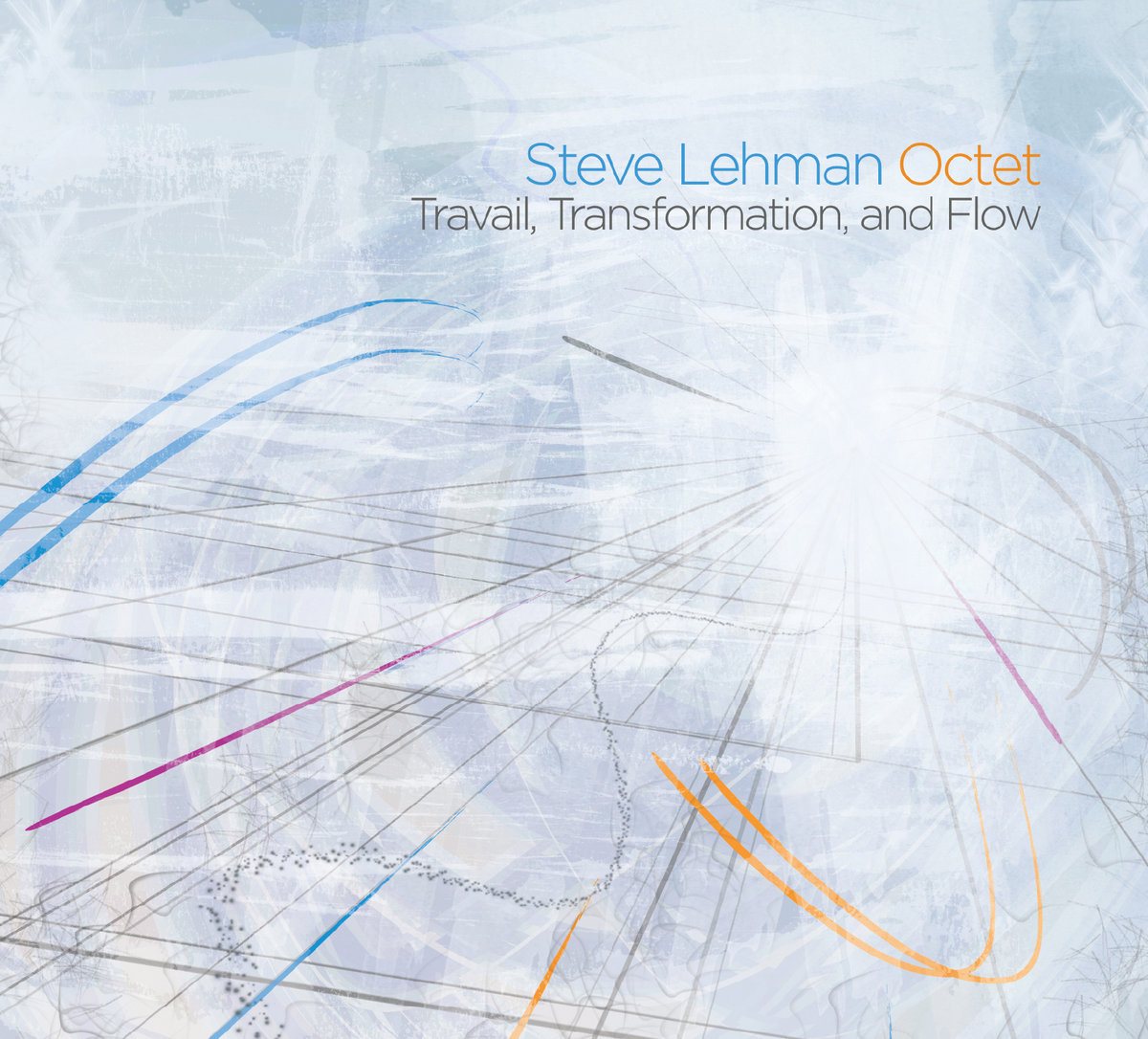
Steve Lehman took his first serious saxophone lessons from Jackie McLean, the hard-bop alto player who cut his teeth alongside Charles Mingus and Art Blakey. He finished his musical education a long way from bebop, taking a doctorate at Columbia under Tristan Murail, the French composer who spent the 1970s building an entire harmonic language out of the overtone series.
Both teachers are audible in Travail, Transformation and Flow.
Released in 2009 under Lehman's own name but built around an eight-piece band, the record applies spectral composition, in which chords are derived from the acoustic physics of a note's overtones rather than from scales or key centres, to a group that still swings. Lehman has described the connection as less of a stretch than it sounds: French spectral harmony ties consonance to raw frequency relationships instead of intervals, which puts it closer to just intonation than to the tempered system jazz normally works in, and gives someone raised on chord changes an unexpected way back in.
The band he assembled to play it reads like a shortlist of New York's most demanding sidemen: trumpeter Jonathan Finlayson, tenor player Mark Shim, trombonist Tim Albright, tuba player Jose Davila, vibraphonist Chris Dingman, bassist Drew Gress and drummer Tyshawn Sorey. Dingman's vibraphone sits underneath the horns rather than soloing over them, softening edges that would otherwise be sharp enough to cut, while Sorey treats the beat as something to be argued with rather than kept, sliding the metre around under the four-horn front line without ever quite losing it.
Rudresh Mahanthappa, another alto saxophonist working the outer edges of jazz harmony at the time, gets a tune named after him, RudreshM, built from the same overtone logic but pushed toward something closer to a duel.
The record saves its boldest move for last. It closes on a cover: GZA's Living in the World Today, reworked into a spectral send-off that lets eight musicians take the album's underlying language out for one final argument before the room goes quiet.
The New York Times named it its jazz album of the year, and it placed in the year-end polls run by both the Village Voice and JazzTimes, a reception that had less to do with novelty than with the fact that the theory never overwhelms the playing. Alloy, the album's ten-minute centrepiece, spends most of its length sounding less like a demonstration of microtonal harmony than like a very good working band figuring out where it wants to go next.
Lehman, who also studied composition with Anthony Braxton and George Lewis and now teaches composition at CalArts, has spent the years since exploring the same terrain in different configurations, from the rap-inflected quartet Sélébéyone to large-ensemble writing for the Orchestre National de Jazz. Travail, Transformation and Flow remains the record where the physics first became a band.