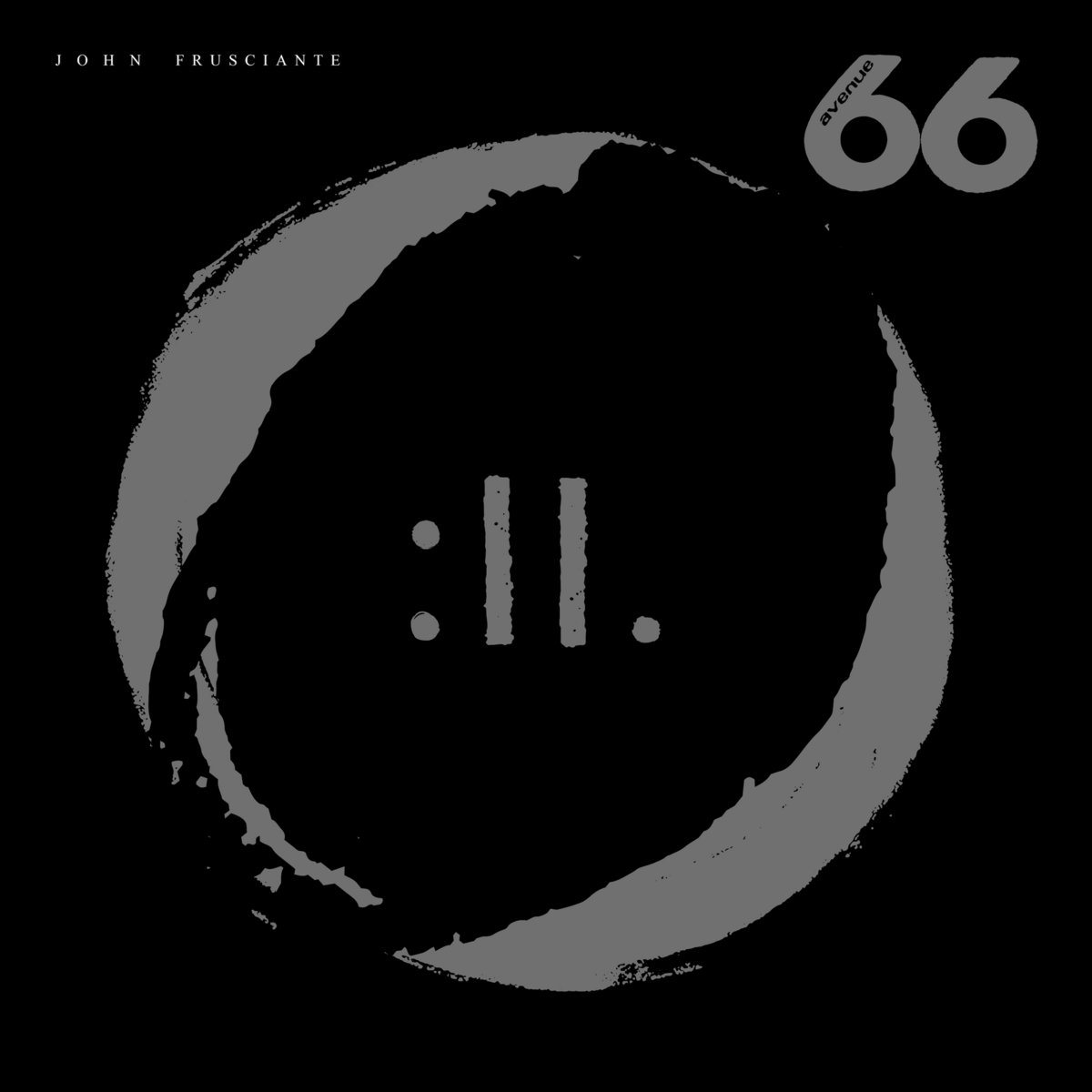
Some of John Frusciante's new record cannot physically exist on vinyl. Not won't — can't. When he pressed the first half of.I: and:II. to wax, several pieces were left off entirely, because, as he put it, they contained frequencies that could not be cut into a groove. The digital and CD edition of:II. carries them instead, ten tracks running past a hundred minutes, built from tones that apparently refuse to sit still long enough for a lathe to catch them.
That is the kind of problem a guitarist doesn't usually have.
Frusciante joined Red Hot Chili Peppers in 1988 at eighteen, weeks after Hillel Slovak's death, left in 1992 overwhelmed by what the band had become, disappeared into years of drug use, got clean, and rejoined in 1998. He has since left and returned twice more, most recently in December 2019. None of that explains.I: and:II.
His solo catalogue always ran wider than the day job suggested: eleven albums and seven EPs moving between hushed acoustic songwriting, glitch-inflected electronics, and, as Trickfinger, straight acid house released through Planet Mu. He has also made two full albums with Omar Rodríguez-López, another guitarist with no patience for staying in one lane. But.I: and:II., released in February 2023 on Avenue 66's Acid Test imprint, is his first record with no songs in it at all.
Made on analogue-style hardware, an Elektron Monomachine and an Analog Four Mark II among them, the album abandons the melodic instincts that define his guitar playing almost entirely. Frequencies rise and decay without resolving into anything a listener could hum. Filters open and close on their own clock. Stray clicks and static drift across the mix, not as rhythm but as weather. He has said he made it after a year and a half of writing rock music with the Chili Peppers left him needing to "clear my head," reaching for Brian Eno's ambient records and, oddly, Jimi Hendrix's more unstructured studio experiments as reference points.
It is not an easy listen, and it was never supposed to be. Frusciante has spent three and a half decades being valued for restraint and melody. Here, for well over ninety minutes, he offers neither, only duration and drift.
The record sits at some distance from Eno's own ambient work, which was built to be furniture, something to half-listen to. This one resists being background for anything. It demands the kind of attention a rock record earns through hooks, except there are none here to grab onto, which is presumably the point Frusciante set out to prove to himself.