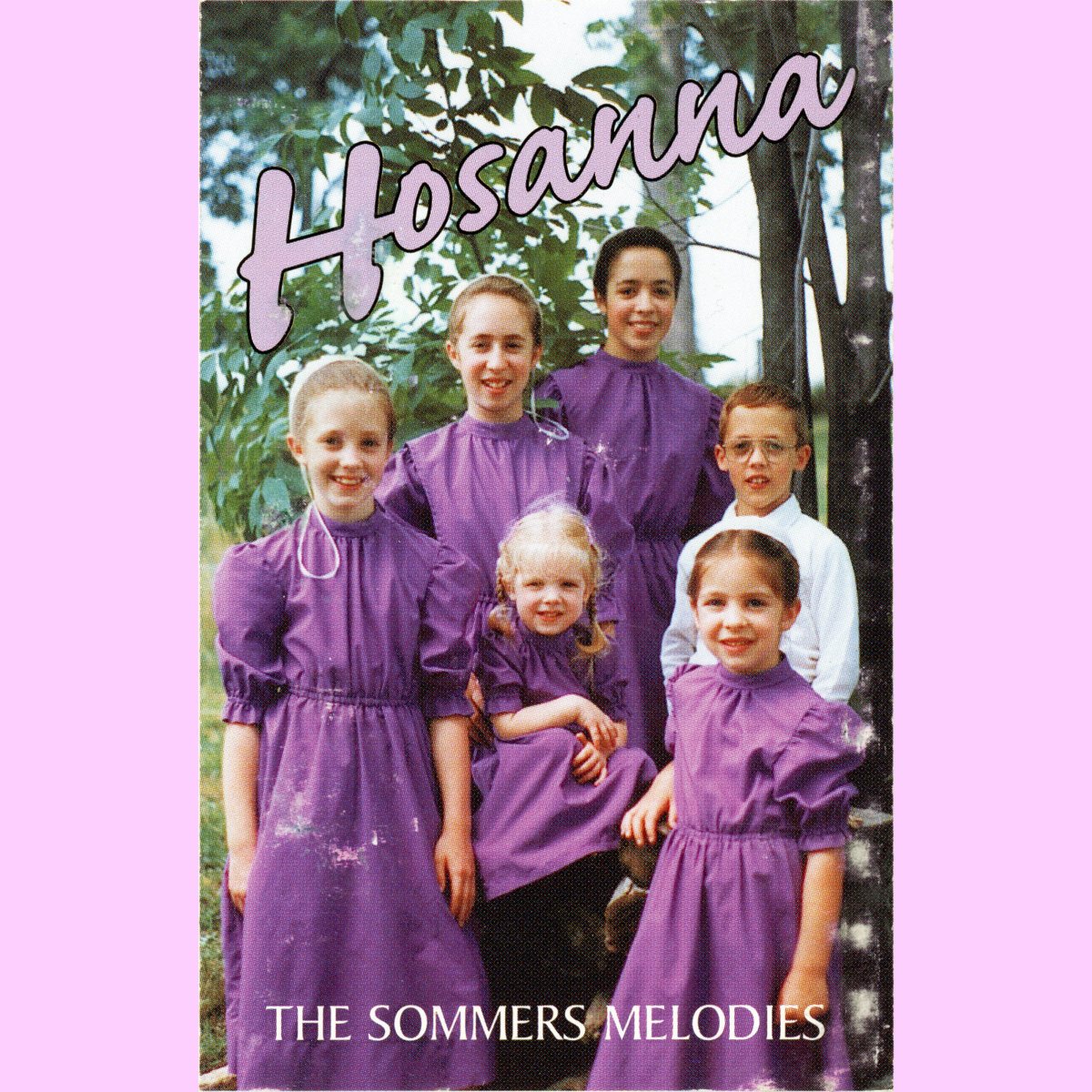
Ezra Fike hates one song on this record so much that he can recite the title without being asked: "That's When We Learn To Fly." Bring up Hosanna, the tape he has just reissued through his archival project The Cassette Archive, and that is the one he mentions first, unprompted, like an old grievance he is still nursing.
The record is not his find. It was his mother's, bought from a Christian or Mennonite mail-order catalogue sometime around 1997 and played on family road trips out of a small Amish town in Missouri, where Fike grew up the child of what he calls the most secular family in an otherwise unsecular church. Twenty-six tracks, credited to a group called the Sommers Melodies, sung entirely by children: unaccompanied harmonies stacked over titles such as "Keep Me Jesus" and "The Gratitude Attitude," the kind of hymnbook plainness that has no interest in irony.
Fike has been rescuing tapes like this since 2019, when a synth-pop cassette called Adimus I turned up at a Missouri thrift store and strangers online refused to believe it was real. The Cassette Archive grew out of that argument, gathering releases chosen for whatever in them still sounds like a person rather than a genre: a ventriloquist singing gospel through his puppet, a Gulf War-era rock record, a lo-fi synth tape indebted to Joy Division. Fike says he is "interested in amplifying the voices of these tiny artists that wouldn't get heard otherwise," and agonises over the artwork for each one.
Hosanna sits apart from that catalogue in an obvious way.
Every other tape in the archive was found. This one was inherited, which means the distance a collector usually gets to keep — that pleasurable remove from someone else's obsession — is not available to Fike here. He is on the record, in a sense, though he never sang a note of it.
Heard without his account of it, Hosanna is a genuinely uncanny listen: children's voices multiplying in close harmony, the recording so plain it borders on the accidental, closer in effect to a Shaker meeting than to contemporary Christian pop. It is the kind of tape that surfaces on genre-agnostic Bandcamp lists precisely because it resists being filed as either kitsch or camp. But Fike, who says he never identified with the "suspenders, linen, head coverings" world pictured on its cover, is wary of the attention the tape has brought his project — wary of listeners who hear atmosphere where he still hears a household rule set to a two-minute tune.
That tension is the record's real subject, more than the hymns themselves are. Hosanna asks to be heard as an artefact. Fike, who lived inside what it depicts, cannot quite grant it that innocence.