In a hotel room in Seoul in 2010, Aki Onda turned the dial of a handheld radio and found, underneath the static, something that sounded uncannily like a voice.
He was in the city on a stay at the Nam June Paik Art Center, steeped at the time in the Korean video pioneer's fascination with shamanism and the idea that broadcast media might carry more than signal. Paik had spent a career treating the television screen as something a spirit could pass through; it was not a large leap for Onda to wonder whose voice this was.
He pressed record.
The twenty minutes that resulted became Seoul (2010), the first of four pieces built the same way over the following four years: gliding the dial of the same handheld radio-cassette machine in Cologne in 2012, Wrocław in 2013 and Lewisburg, Pennsylvania, in 2014, and keeping whatever the static handed him, with only light editing after the fact.
This is how Onda has worked since the late 1990s. Since 2004 his Cassette Memories project has drawn on a sound diary he records obsessively on a Walkman he carries everywhere, and he describes the process as finding rather than making. He spent seventeen years based in New York before moving back to Japan, settling in Mito, in 2020, the same year this record finally surfaced.
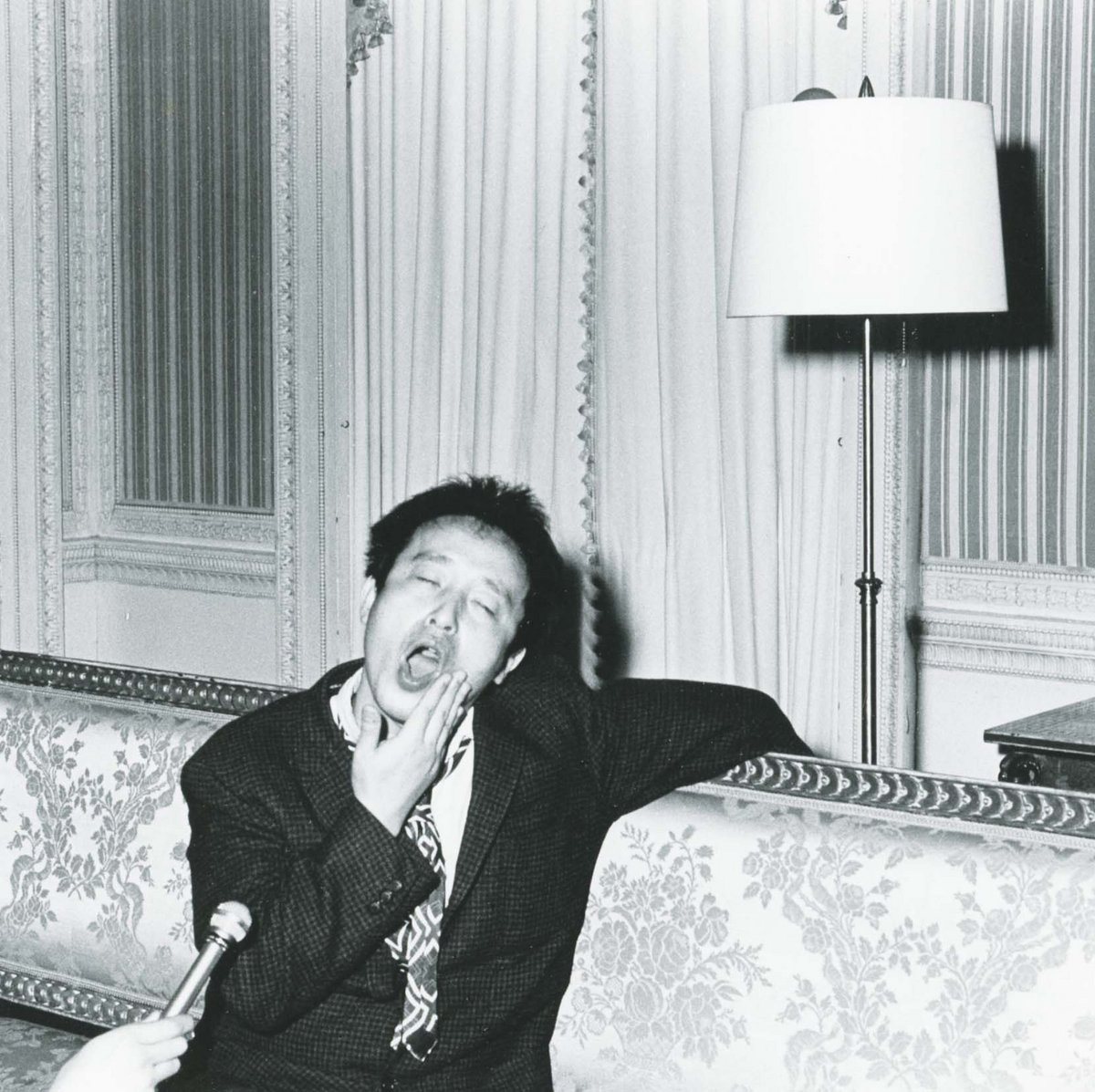
Michael Snow, the Canadian filmmaker, is a recurring collaborator; the two have performed as a trio with guitarist Alan Licht for over a decade, and archival photographs of Paik taken on the set of Snow's 1974 film Rameau's Nephew fill the album's booklet, alongside a remembrance by the artist Yuji Agematsu and two essays on radio-wave phenomena.
The four transmissions share a noisy, percussive grain despite being recorded on different continents years apart, a texture that might simply be the fingerprint of one machine's motor and heads imposing itself on everything it swallows. Onda never settles the question of whether that's mechanical accident or something else, and the record is stronger for leaving it open.
Documenta 14 commissioned the project for its radio programme in 2017, broadcasting it through its international network of partner stations before Onda anchored it to vinyl: a limited run of 250 copies on Sean McCann's Recital label, released in June 2020.
Paik staged his own séance once, in 1990, summoning Joseph Beuys through a Korean mudang ritual he titled A Pas de Loup. Onda's version trades ceremony for equipment, but the premise survives the transfer: that a channel built for one kind of signal might, if the dial keeps moving long enough, let something else through.