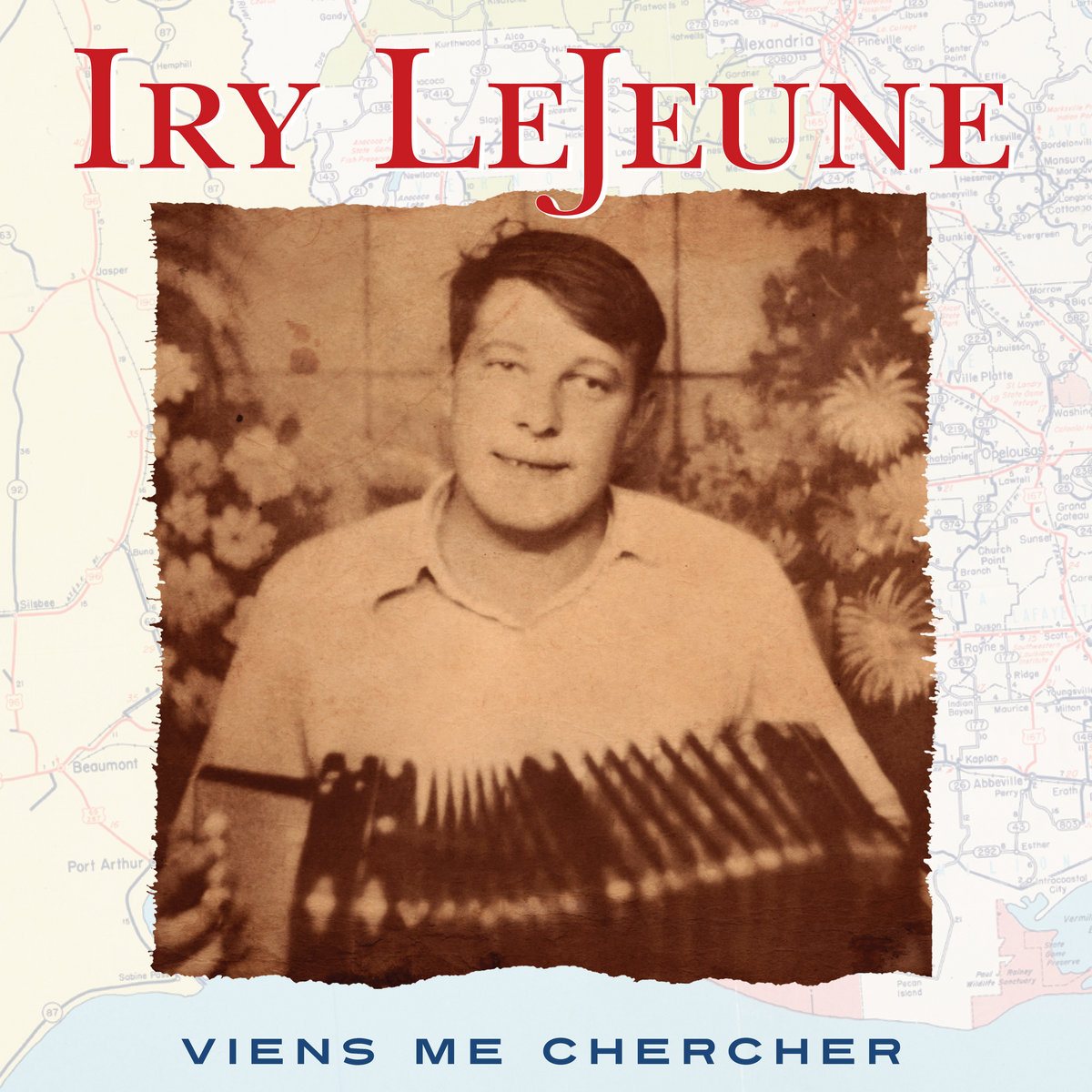
Iry LeJeune could make a small button accordion sound larger than the room around it. The instrument pumps and snaps; his voice rises above it with a grain that turns a dance tune into something closer to confession. That tension — rhythm built for bodies, singing weighted with hurt — is the centre of his music.
Viens Me Chercher, released on 28 March 2025, makes that contradiction newly vivid. Its 31 tracks gather familiar recordings alongside previously unheard masters, alternate takes, studio talk and a rare radio performance. Rather than polishing LeJeune into a monument, the set lets the seams show. Alternate performances reveal how readily he altered phrasing and attack, treating songs as living material rather than fixed objects.
LeJeune’s recorded career was brutally short. Born in 1928 and nearly blind, he made only 25 songs during his lifetime before his death in 1955 at 26. Yet from 1949 his recordings for Folk-Star, Goldband and TNT helped return the accordion to the foreground of Cajun music after the instrument had lost ground to string-band styles.
The lineage matters. LeJeune absorbed the repertoire and technique of Creole accordionist Amédé Ardoin, whose playing had already demonstrated how much melodic movement could be wrestled from a one-row instrument. LeJeune carried that vocabulary into the post-war dancehall: stepped figures, compressed rhythmic surges and ornaments that seem to tumble over the beat without losing it. He also drew on Jimmie Rodgers and wrote songs of his own, placing Cajun French expression beside the emotional directness of American country music.
But technique alone does not explain why these recordings endure.
LeJeune’s singing is the destabilising element. On a title such as I Made a Big Mistake, heartbreak is not decorative subject matter; the vocal sounds physically pressed against the microphone and the limits of the recording equipment. Wilson Granger’s fiddle and Alfred Cormier’s guitar can frame that intensity, but LeJeune remains the gravitational force.
The compilation grew from work by Southern Folklife Collection curator Steve Weiss, who examined original LeJeune masters in the Goldband Collection and uncovered unheard tapes and alternate takes. That archival origin gives Viens Me Chercher its unusual intimacy. It is not simply a sequence of canonical sides. It catches repetition becoming variation, and preservation becoming a way of hearing personality.
For a musician whose life left so little time for a discography, LeJeune occupies an enormous space. These recordings explain why: the accordion drives the dance, while the voice keeps finding the bruise underneath it.