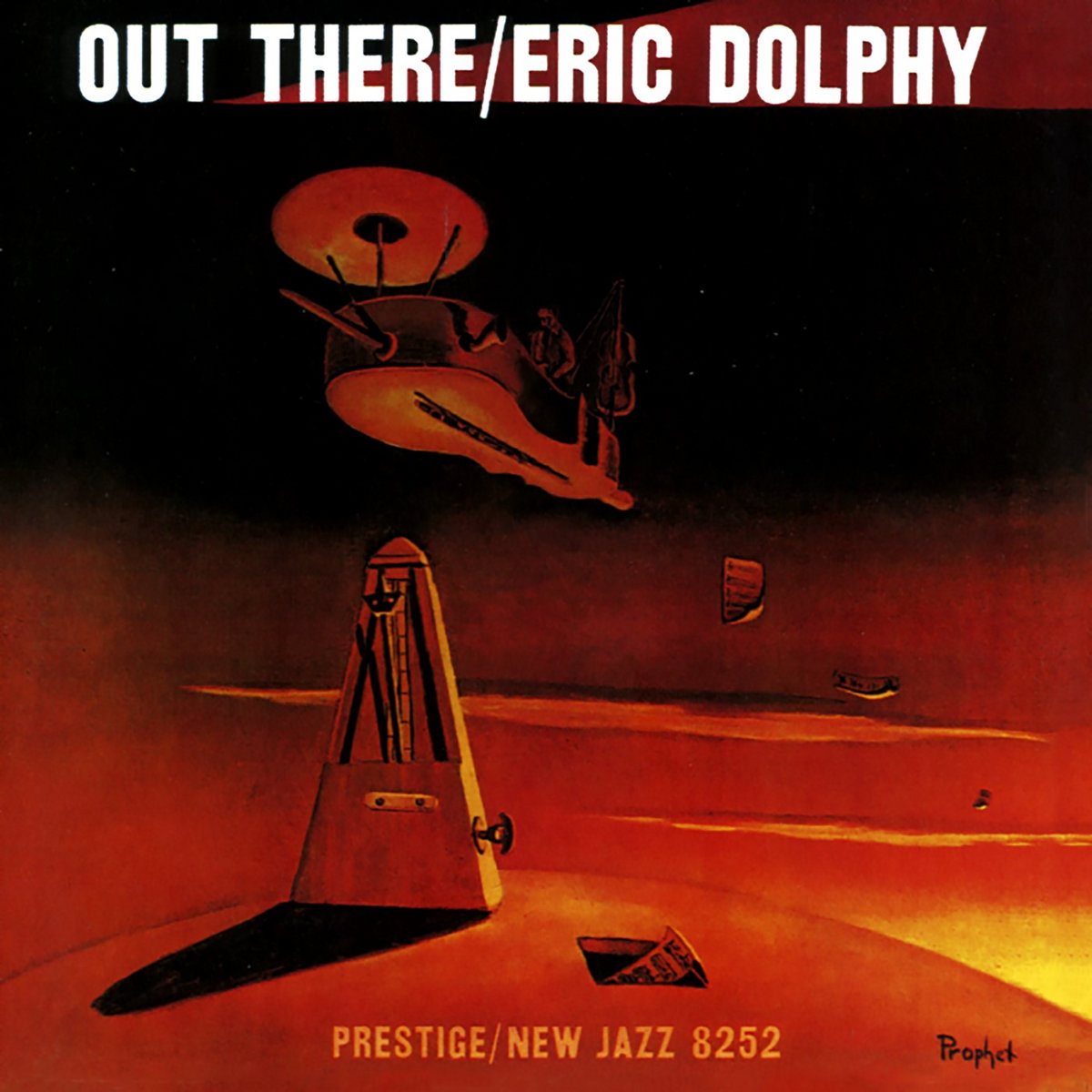
Eric Dolphy turned ninety-eight yesterday, or would have. He died in 1964, thirty-six years old, but the arithmetic still lands strangely on a record like Out There, cut when he was thirty-two and already sounding like nobody had told him what a saxophone was supposed to do.
The record's defining decision is an absence. There's no piano, no guitar, nothing to lay down chords for Dolphy to sit inside. In their place: Ron Carter on cello, George Duvivier on double bass, and Roy Haynes on drums, an instrumentation that leaves Dolphy's alto saxophone, bass clarinet, clarinet and flute with almost nothing to react against but Carter's bowed lines. Carter, who'd go on to become one of the most recorded bassists jazz has produced, is here doing something rarer: playing cello, weaving contrapuntal lines against Dolphy rather than anchoring the harmony from below.
That openness is the point.
Without a chordal instrument dictating the changes, Dolphy and Carter can move freely between tonal centres, and the record's harmonic ground shifts underfoot in a way conventional post-bop rarely allows. Dolphy's phrasing, always built on unusually wide intervals and a vocal, almost avian quality he carried across every instrument he touched, has room here it wouldn't get in a more crowded arrangement.
Dolphy grew up in Los Angeles, the son of Panamanian immigrants, studying clarinet and saxophone from the age of six. His break came with drummer Chico Hamilton's group in 1958, and by the time he cut Out There at Van Gelder Studio on 15 August 1960, he'd already relocated to New York and joined Charles Mingus's Jazz Workshop, an association that shaped his sense of a band as a living, arguing organism rather than a fixed arrangement. Within a year of this session he'd be playing alongside John Coltrane, another musician willing to treat harmony as a suggestion rather than a rule.
The material on Out There splits between Dolphy's own writing and pieces by Mingus, Randy Weston and Hale Smith, released the following September on New Jazz. It sits at the edge of what critics of the period were calling third stream, jazz reaching toward classical composition's structural ambitions, though Dolphy's version of that reach always stayed rooted in blues phrasing underneath the abstraction.
Sixty-five years on, the record still sounds less like an experiment than a plainly stated argument: that a band can generate its own gravity without anyone playing the chords.