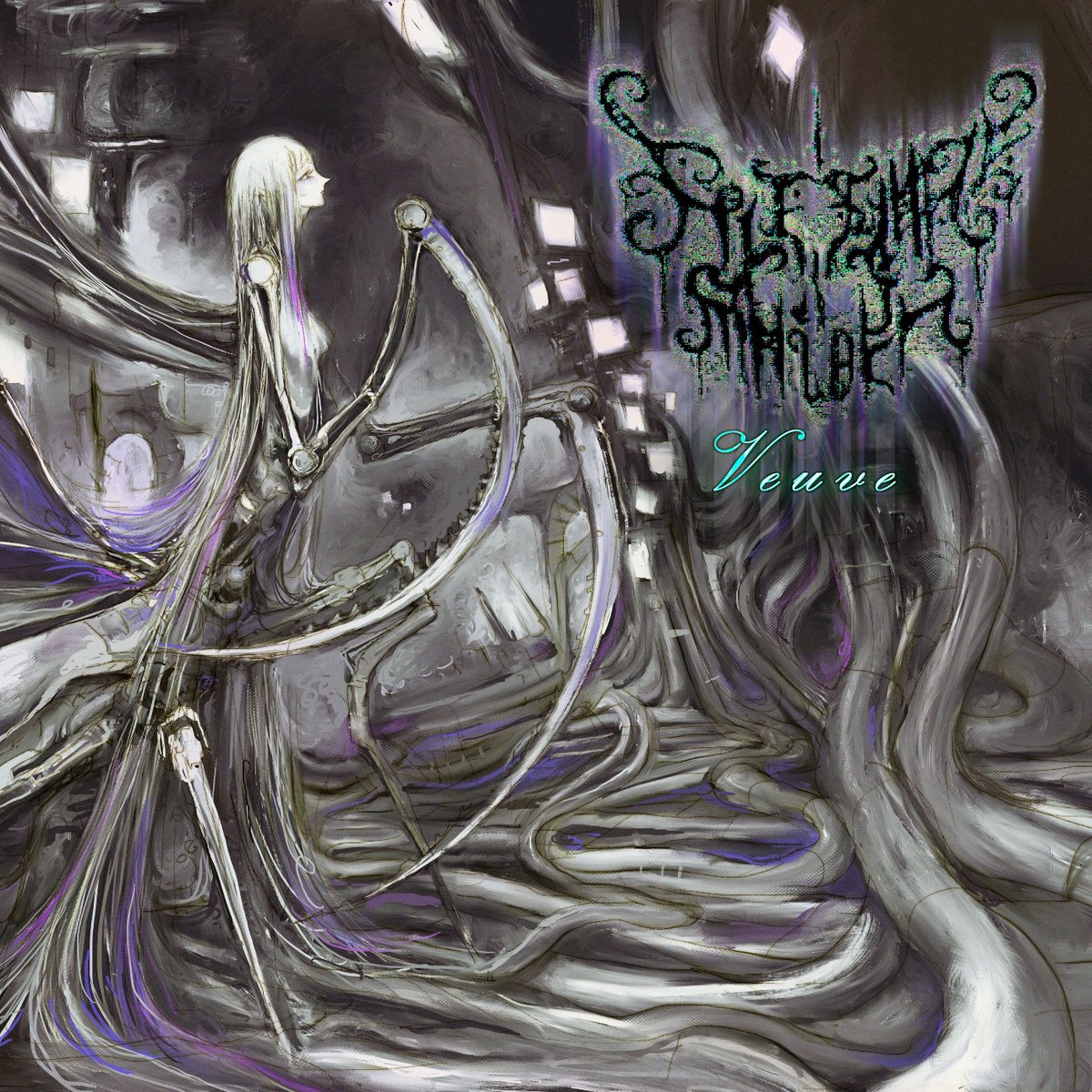
FILESHAREMAIDEN keeps her band's mythology short and blunt. “They're all in a kind of fucked, post-apocalyptic, nothing world, where nothing is happening, and there's no one, and it's just kind of barren,” is how Alice Simard explains the universe behind Veuve, the project's first and so far only full-length album.
In that world a machine called Arisu (Simard's own name, more or less, “and I thought it was cute”) keeps the last scraps of civilisation running, tended by a set of “maidens” married to its core. Filesharemaiden is one of them, and Veuve's ten songs are what she has to say for herself about the work.
The character behind the songs is described, in the project's own mythology, as an entity that “lives by the source” and “funnels code through an immense network of wires” — the concept is less a costume than a persona she inhabits fully enough that the album plays like, in her words, “a diary of her deepest insecurities, urges, feelings and rage.”
The whole conceit reads like an outtake from Serial Experiments Lain or Neon Genesis Evangelion, and it is meant to.
Tech-death has always had a soft spot for dystopian science fiction — vast riff complexity pairs naturally with vast imagined systems — but Simard's reference points are unusually specific for the genre. Serial Experiments Lain, from 1998, and Neon Genesis Evangelion, which ran from 1995 to 1996, are both anime about the collapse of the border between a person and the network or machine they are plugged into, and that is exactly the anxiety Veuve is built to dramatise rather than simply gesture at.
Released on 9 June 2024 from Quebec City, Veuve is billed as progressive or technical death metal, but the ten track titles are entirely in French — Antennes démantelées, Félins moroses, Désordre, hémorragie — and the music matches that specificity: knotted, constantly modulating riffs that refuse to repeat themselves twice, stacked over an actual science-fiction plot rather than the vague dystopian mood tech-death usually settles for.
The record's other voice belongs to Eetu Hernesmaa, the Finnish musician better known from the band Chiliasm, who plays fretless bass across the album with a looseness that has nothing to do with sloppiness — gliding pitch and vibrato where a fretted instrument would give hard, correct notes, exactly the kind of instability the concept calls for.
FILESHAREMAIDEN is one alias among Simard's twenty-seven and counting, but it is the one that pulls together the most of what she does elsewhere piecemeal: the world-building, the technical density, the outside collaborator, the concept holding still long enough to be called a story rather than an atmosphere. Nothing else she has released quite adds up the same way.