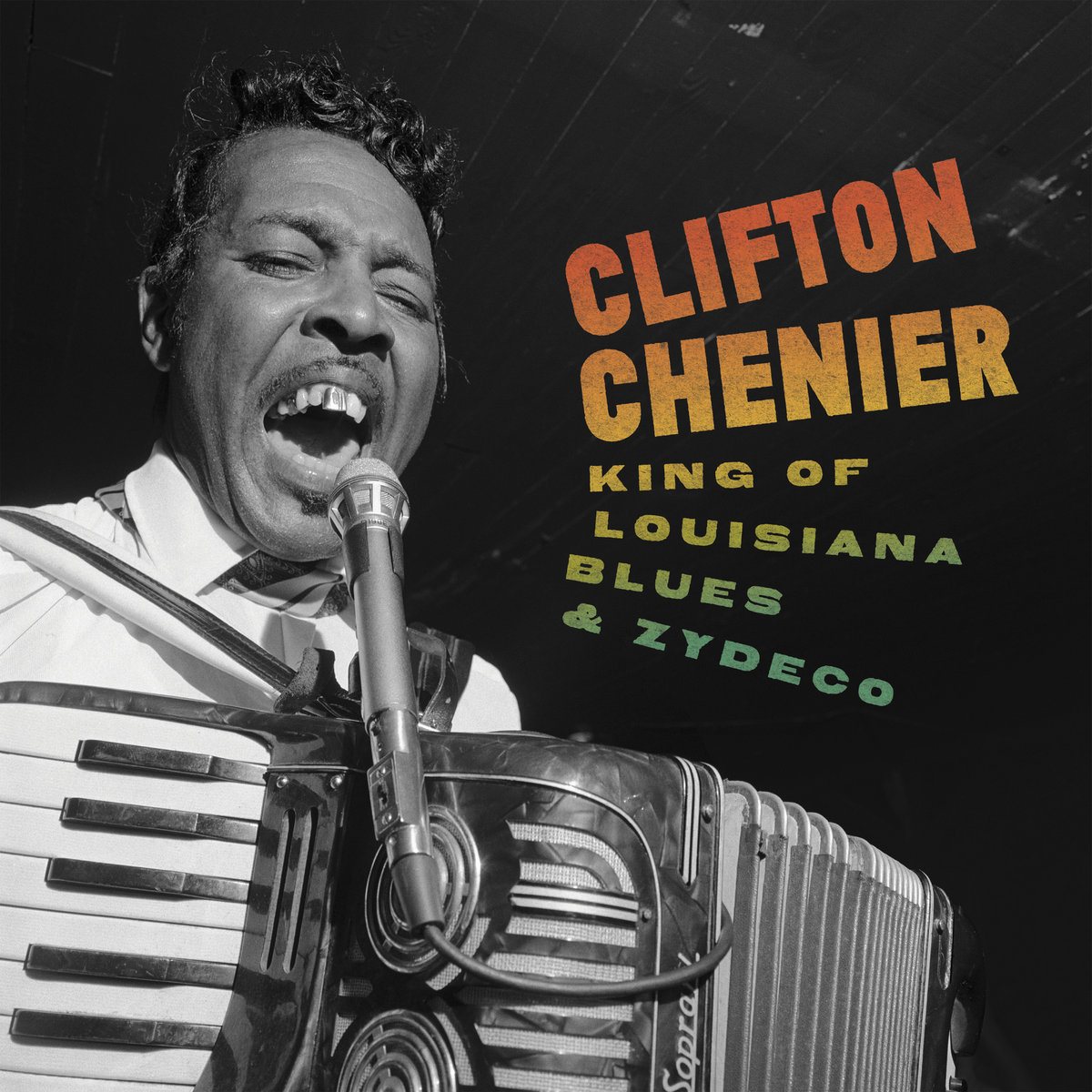
Clifton Chenier’s accordion does not ask permission to enter the blues. It arrives as rhythm section, lead instrument and provocation at once: piano keys flashing over a groove that can pull from Creole dance music, R&B and rock ’n’ roll without treating any of them as museum pieces.
King of Louisiana Blues and Zydeco, released on 6 February 2026, puts that argument across 67 tracks. The scale suits Chenier because his importance is not contained by one signature song. His achievement was a method: take the older Black Creole music of south-west Louisiana, put the piano accordion at its centre, and make it converse with whatever was electrically alive around him.
Chenier was born near Opelousas, Louisiana, in 1925. His father played the one-row button accordion, but Clifton chose the larger piano accordion, an instrument whose keyboard opened different melodic and harmonic routes. By the 1950s he was recording a music that could sit beside rhythm and blues while remaining unmistakably rooted in Louisiana. The frottoir — the metal rubboard played by his brother Cleveland Chenier — supplied a dry, insistent counter-rhythm that became equally fundamental to the sound.
The point was never preservation for its own sake.
When Chris Strachwitz recorded Chenier in the 1960s, Chenier wanted rock ’n’ roll in the room as much as French Creole music. That friction produced records in which a blues progression might carry French lyrics, while the accordion behaved with the force and elasticity of a horn or electric keyboard. Songs such as Louisiana Blues and Zydeco et Pas Sale show how naturally those elements could occupy the same floor.
His Red Hot Louisiana Band carried that sound far beyond the regional circuit. Chenier played the Fillmore, appeared at Carnegie Hall and toured Europe. He won a Grammy for I’m Here! and became a National Heritage Fellow in 1984. His 1970s recording Bogalusa Boogie later entered the Grammy Hall of Fame.
Chenier died in 1987, but the box set lands in a moment when his vocabulary remains audible across contemporary zydeco. That does not mean the genre froze around his piano accordion: button accordions returned forcefully, and younger players have pushed zydeco through new production styles. What Chenier established was permission to move.
That is the useful way to hear King of Louisiana Blues and Zydeco: not as an archive sealing a tradition behind glass, but as evidence of a musician who understood tradition as something sturdy enough to be changed.