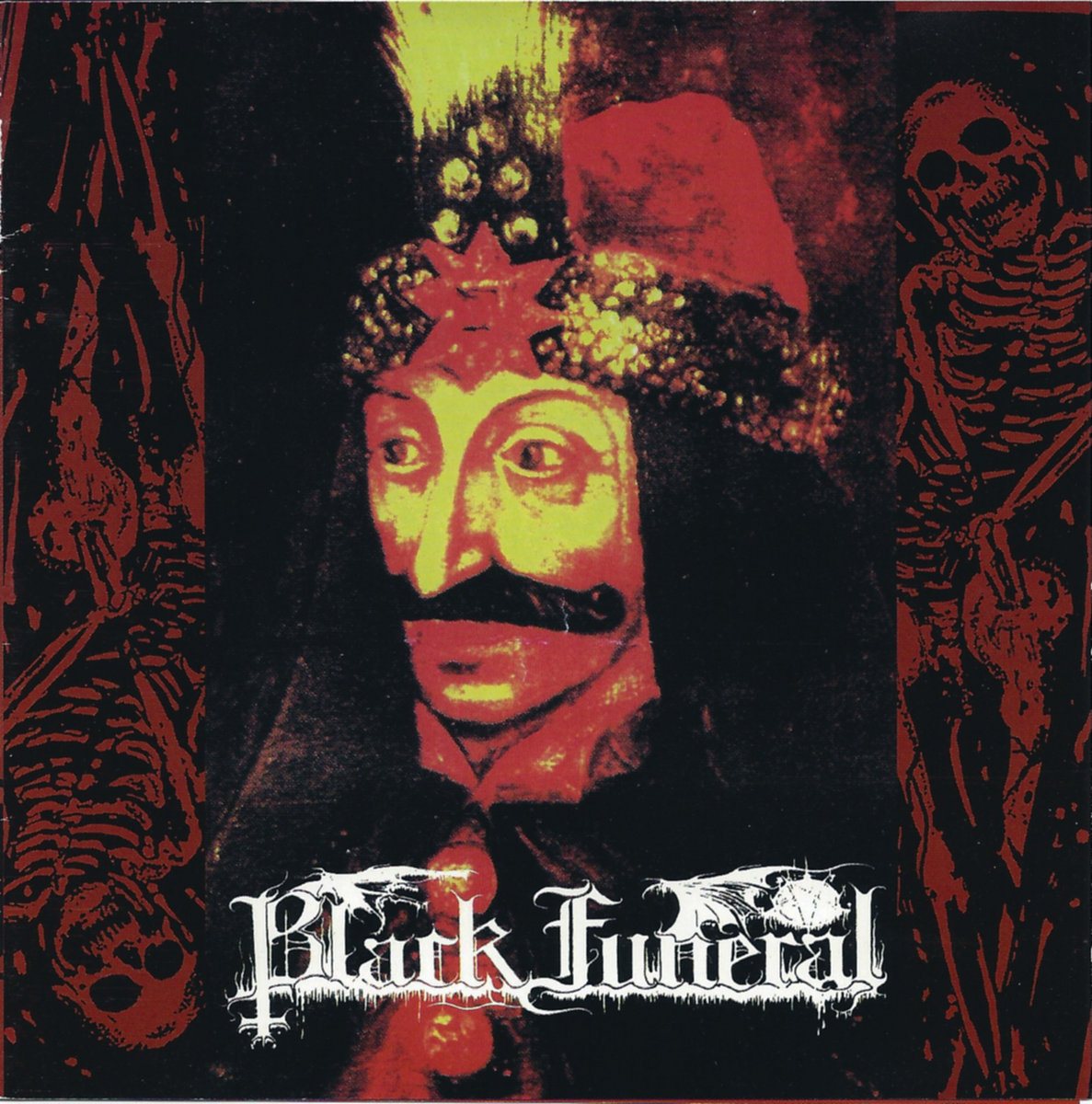
The singer credited as Baron Von Abaddon on Black Funeral's Vampyr - Throne of the Beast has another job title. Under his own name, Michael W. Ford, he has published dozens of books on Luciferian philosophy, witchcraft and vampirism, and has helped lead a Texas-based religious organisation built around Left-Hand Path practice. Not many vocalists on a 1995 black metal record can say that about themselves. Fewer still make it sound like the day job informs the songs rather than the other way round.
Black Funeral formed in 1993, with Ford at the centre of a rotating cast that on Vampyr comprised Dean Tavernier and Jim Hensley on guitars and bass, John York on drums, and Desolate Wings on synth. The album, released two years later on Full Moon Productions, arrived at the tail end of American black metal's earliest wave, when the genre in the United States was still mostly a scattering of tape traders working from Norwegian blueprints. Black Funeral had a different set of references.
Where most vampiric black metal of the period treated the vampire as an image — corpse paint, cheap horror-film iconography, a costume for aggression — Ford wrote from inside the folklore itself. Track titles like "Ex Sanguini Draculae" and "Spectral Agony of Pain and Loneliness" draw as much on European vampire legend and ceremonial magic as on genre convention, and the record's slower passages, thickened by Desolate Wings' synth, sit closer to ritual music than to the buzzsaw tremolo riffing coming out of Norway at the time.
That's the distinction critics keep landing on: Vampyr - Throne of the Beast reads less like a metal band borrowing vampire imagery for shock value and more like an occultist who happens to make black metal. It set a template Black Funeral kept working through follow-ups like Empire of Blood and Moon of Characrith later in the decade, each one leaning further into ambient texture and ritual pacing rather than speed.
Ford has gone on to found or contribute to a long list of other projects — Akhtya, Valefor, Atra Mors, Strigoii among them — each one splitting time between music and the parallel career in esoteric publishing that has, by now, outpaced the discography several times over. Three decades after Vampyr, it still gets cited as one of the foundational US black metal vampire records, less for its raw production than for the sense that its author actually believed what he was singing about — which, for a genre built almost entirely on theatre, remains a fairly rare thing to pull off.